
Parenting
Model building for adults: how to choose

May
There’s a huge difference between spending an hour scrolling a screen and spending an hour fitting gears, wheels, and joints together with your own hands. Adult construction modeling is appealing precisely for this reason: it turns free time into something tangible, relaxing, and beautiful to look at once finished. It’s not just a technical hobby. It’s a creative activity that combines focus, manual skill, and the rare pleasure of seeing an object take shape piece by piece.
For many adults, the first doubt is simple: where do you start? The answer depends less on experience and more on the type of satisfaction you’re looking for. Some want a decorative model to display at home, others prefer a mechanical project with moving parts, some desire a calm pastime to unwind after work, and others seek an original, intelligent, and non-impersonal gift. Understanding this helps in choosing well from the very first kit.
Why adult construction modeling really works
The appeal isn’t just in the final result. It’s in the process. Assembling a model requires attention, but not in the stressful way of certain complex activities. On the contrary, it offers a clean, concrete, almost meditative focus. Hands work, the mind concentrates, and time changes pace.
That’s why modeling appeals even to those who wouldn’t call themselves enthusiasts. You don’t need to be an expert in mechanics or have a lab workstation. The most accessible kits today are designed to make assembly clear, progressive, and rewarding. When the model is made of natural wood, requiring no glue or special tools, the experience becomes even more immediate. You open the box, organize your workspace, and truly begin.
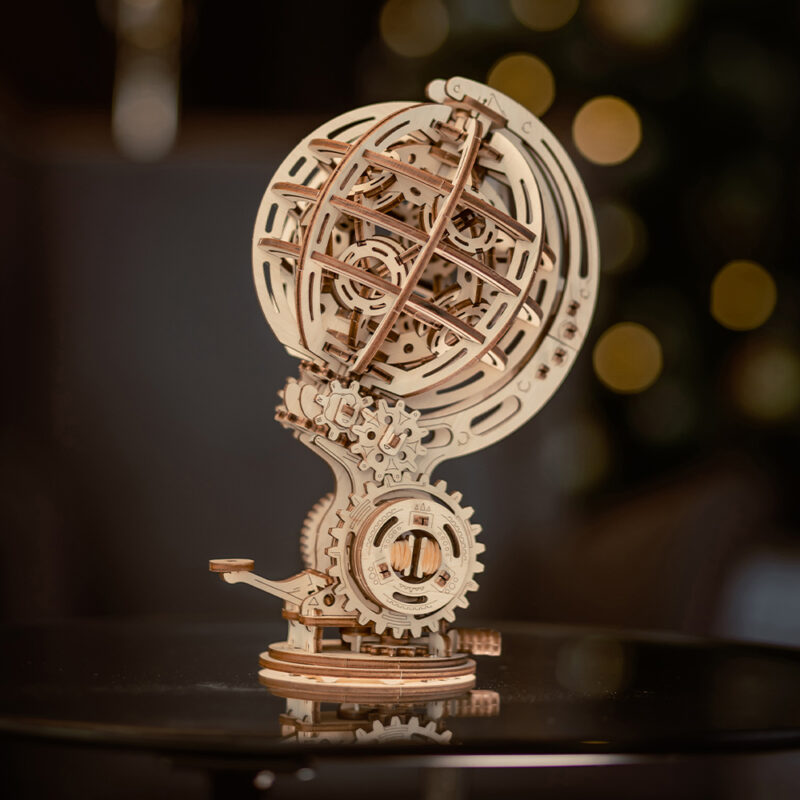
Then there’s an aspect that often convinces even the most skeptical: aesthetic value. A wooden tractor, a retro car, a train, or a wall-mounted globe aren’t just pastimes. Once completed, they become decorative objects with character, perfect for a study, living room, or bookshelf.
Which adult construction modeling to choose
Here’s where the practical part comes in. There’s no single right kit. There’s the right kit for the moment, for the experience level, and for personal taste.
If you’re a beginner, it’s best to avoid overly ambitious models just because they look spectacular in photos. A simple but well-designed kit gives more satisfaction than an advanced project left half-finished. Entry-level models are ideal for getting familiar with joints, instructions, and assembly times. They offer a very faithful first taste of the experience without creating frustration.
Those who already have good manual skills can look toward more complex mechanical 3D puzzles. In this case, the fun increases because the number of steps, the required precision, and often the final effect grow. Seeing a wooden mechanism work without batteries has a special charm. It’s not just about design. It’s the pleasure of understanding how the parts interact with each other.
The theme also matters a lot. An adult passionate about vehicles will likely feel more engaged with vintage cars, locomotives, or tractors. Those who love decor or scenic details may prefer globes, decorative objects, or display models. Those looking for a gift tend to choose universal subjects, nice to assemble and easy to appreciate even afterward.
Wood, mechanisms, and glue-free assembly
Among the reasons modern kits are winning over more and more adults is the quality of the assembly experience. Wood offers a different feel compared to plastic. It’s warmer, more natural, more pleasant to touch. It conveys craftsmanship and makes each project more personal.
Glue-free assembly is another concrete advantage. It doesn’t make a mess, requires no special tools, and lowers the entry barrier. This matters a lot for those who want a nice hobby that’s simple to start. You can assemble it on the home table without turning the living room into a workbench.
Mechanical models, then, add an extra layer. Gears, levers, wheels, and moving parts make the process more engaging and bring out the intelligent side of the product. It’s not just about assembling a shape. You build a function. And that’s precisely what makes wooden modeling so cross-cutting: it appeals to DIY lovers, design enthusiasts, and those seeking an educational but not childish activity.
How difficult should a kit be
Here, a simple rule applies: the right level is one that keeps attention high without dampening enthusiasm. A model that’s too easy can be forgettable. One that’s too complex risks turning relaxation into effort.
For an adult beginner, medium difficulty is often the best choice. There’s enough challenge to make assembly interesting, but not so much as to create constant blocks. If you already have experience with 3D puzzles or traditional modeling, it makes sense to level up and look for more sophisticated mechanisms, models with more pieces, or constructions with strong visual impact.
Even the time available matters. A kit is chosen well when you consider how many assembly sessions you want to dedicate. Some love to finish a project in an afternoon, while others prefer to spread it over several evenings. Neither option is better than the other. It just changes the type of experience.
When it’s the right gift
Adult model building is one of those gift ideas that work because they surprise without being complicated to understand. It's not a passive object. It's an experience. And that makes it more personal than many standard gifts.
It works well for birthdays, parties, anniversaries, Christmas, or simply as an original thought for someone who loves creating with their hands. The advantage is twofold: on one hand, you give a moment of quality offline time, on the other, you offer an object that, once completed, remains.
For a gift, it's best to focus on models with a strong theme and immediate aesthetic. Retro cars, trains, dinosaurs, or globes have a very clear impact and adapt well to different tastes. If you know the person well, choosing a kit linked to a specific passion makes everything even more spot-on.
An adult hobby, but accessible
There are still those who think of model building as a niche pastime, complicated, or reserved for those with a lot of experience. In reality, part of its current success depends precisely on the opposite. The best kits are designed to be accessible, clear, and satisfying even for those starting from scratch.
This doesn't mean they are trivial. It means they are well thought out. Readable instructions, precise materials, reliable fits, and a coherent assembly progression make all the difference. A good kit guides, not confuses. And when the project is well designed, the final feeling is that of having built something special without having to overcome unnecessary obstacles.
In this sense, realities like Puzzle3D have brought model building closer to many people's daily lives. Not only for the variety of subjects, but for the way the product is presented: as a creative, relaxing, educational, and decorative experience all at once.
How to know if a model is right for you
The best choice comes from three very simple questions. Do you want to relax or challenge yourself? Do you prefer a decorative object or a working mechanism? Are you looking for a project for yourself or a gift?
If you want to unwind, focus on a linear model, with balanced difficulty and a visually pleasing result. If you enjoy understanding how the fits work and seeing moving parts in action, mechanical 3D puzzles are the most engaging path. If you are buying for a gift, the final effect matters a lot in addition to the assembly experience.
It's also worth considering the space at home. Some models are perfect for a shelf or a desk, others become true decorative elements. Those who love beautiful objects to display often find a double satisfaction in model building: building and then showcasing the result in the environment.
More than a pastime
The reason this hobby continues to convince so many adults is simple: it offers a complete reward. There is the pleasure of hands working, the mind focusing, time slowing down, and the finished object that remains. Few pastimes manage to bring together all these aspects without becoming complicated or scattered.
If you are thinking of starting, there's no need to search for the perfect model in the abstract. You need to choose the one that truly invites you to sit at the table and begin. The right kit is the one that makes you want to assemble the first piece, then the second, and then continue until you see something born that previously existed only in your attention.