

Parenting
Natural wood vs plastic modeling
Jun
When you open a model kit box, you can feel the difference right away in your fingers. The comparison of natural wood vs. plastic modeling isn't just a matter of taste: it changes how you build, the time you spend on the model, and even the final result that stays in your home, on a desk, or in a bedroom.
For those seeking a creative activity to share, an original gift, or a relaxing project to assemble at a leisurely pace, the choice of material matters more than it seems. There is no single right answer for everyone, but there are very concrete differences that help you understand which model truly makes sense for your age, experience, and expectations.
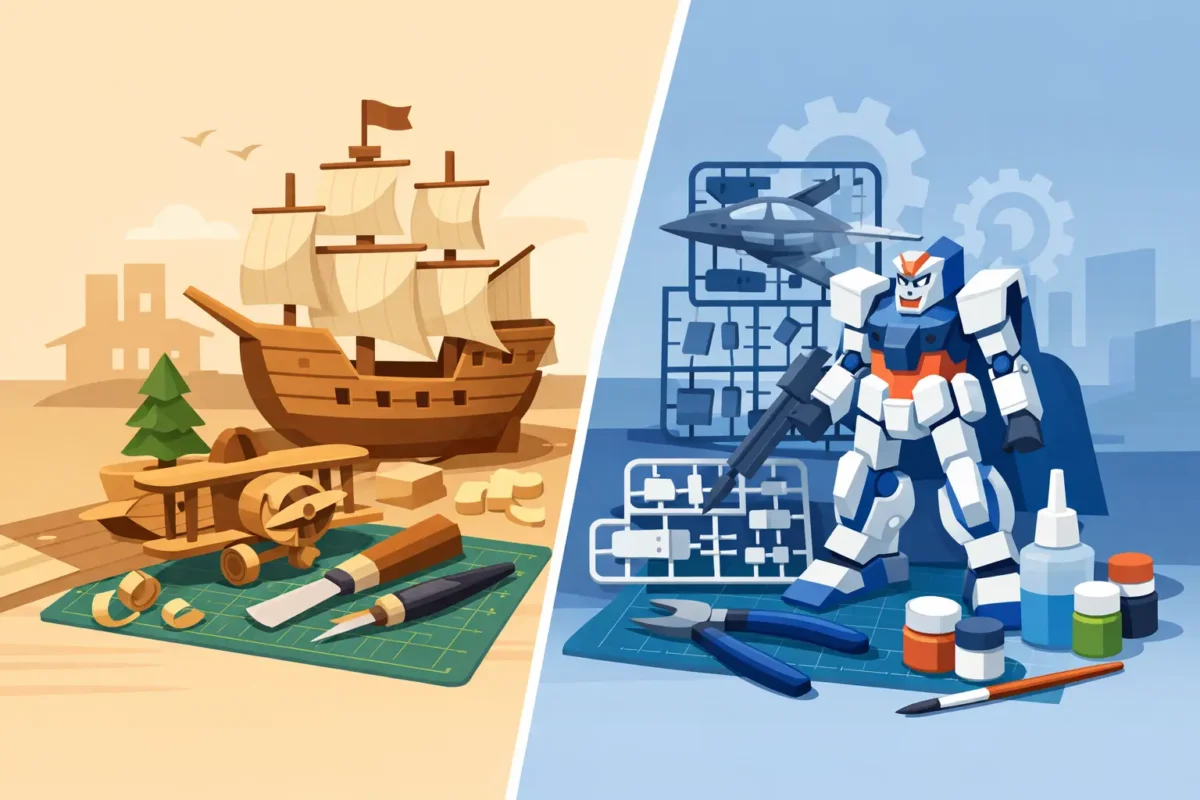
Natural wood vs. plastic modeling: what really changes
Natural wood offers a more tactile, warm, and visual experience. The grain, color, smell of the material, and the feel during assembly make each construction feel closer to a piece of furniture or a small craft project. It's not just a model to finish: it's often something you want to display.
Plastic, on the other hand, was historically born for industrial precision and a wide variety of complex shapes. In many kits, it allows for fine details, uniform surfaces, and more standardized finishes. For some enthusiasts, this is an advantage, especially if they seek technical accuracy or are accustomed to a more traditional approach to tabletop modeling.
The real difference lies in the overall experience. Wood tends to turn assembly into a more intuitive, tangible, and decorative moment. Plastic often requires a more technical approach, with greater attention to accessories, finishes, and assembly steps.
The assembly experience is completely different
Those who approach modeling to relax, spend quality offline time, or share an activity with a child usually greatly appreciate the simplicity of wood. Well-designed wooden kits have a clear advantage: they can be assembled without glue or special tools. This lowers the entry barrier and makes the experience more immediate, even for beginners.
With plastic, however, assembly can become more delicate. It often requires more precision in separating parts, more attention to connection points, and, in many cases, more careful handling of glue, paints, or tools. For the experienced hobbyist, this is part of the pleasure. For a family or someone buying a gift, it can become an obstacle.
Then there is another often underestimated aspect: the pace. Natural wood accompanies a type of construction that is satisfying even during the process, not just when finished. Each piece that falls into place immediately makes the model's shape readable. It's a simple but very effective gratification.
For children, adults, and beginners
If the recipient is 7 years old or older, or has never built a model before, wood is often the most accessible choice. Not because it's trivial, but because it's clear, clean, and less distracting. It helps focus on assembly, the logic of mechanisms, and manual dexterity, without adding too many side complexities.
For a passionate adult, however, it depends on the goal. If they are looking for a creative experience with moving parts, gears, and mechanical satisfaction, wood has a lot to offer. If they are primarily seeking painting, extreme customization, or technical reproduction of a specific vehicle, plastic can remain interesting.
Final aesthetics: hobby object or decorative element?
Here, wood has a strong personality. A natural wood model tends to integrate well into the home: on a bookshelf, a shelf, a desk, or in a child's room. It has a warm, clean, decorative appearance. It doesn't just look like a completed pastime, but an object with visual presence.
Plastic offers a different aesthetic, often more tied to classic collecting. If the model is well-painted, the result can be very scenic. However, in its basic form, it can sometimes risk appearing more technical than decorative, especially in home environments where harmony with furnishings and natural materials is sought.
For someone buying a kit also as a gift idea, this detail matters. A 3D puzzle or a mechanical wooden model works both as an experience and as a final result to display. It's one of those gifts that doesn't end up in a drawer after a weekend.
Durability, resistance, and maintenance
It is often thought that plastic lasts longer overall. In reality, it depends on use. Plastic withstands light impacts and humidity well, but some small parts can be fragile, especially if thin or under tension. Furthermore, over time, certain surfaces can lose their appeal, yellow, or show visual signs more easily.
Natural wood, if well-crafted and used in normal home environments, holds up excellently. It doesn't like excessive humidity, that's true, but it offers a pleasant stability and a feeling of solidity that many find more satisfying. In mechanical models, the quality of the cut and the design makes more of a difference than the material itself.
There is also a theme of emotional maintenance, if you will. A wooden object is often treated with more care because it conveys value. It may seem like a detail, but it changes the relationship with the finished model.
Educational Value and Quality Time
When it comes to family modeling, the material also affects learning. Wood has a great advantage: it makes the structure visible. The joints, gears, movements, and proportions are easy to observe and understand. For children, teenagers, and curious adults, it is a very concrete way to train logic, patience, and coordination.
Plastic can be educational in its own way, but it often communicates an experience more focused on the final result than on the process. With wood, however, the process is a central part of the pleasure. You build, observe, and understand how it works. This makes it very suitable for those who want intelligent entertainment, away from screens and closer to real hands-on activity.
Unsurprisingly, wooden kits appeal both to those seeking relaxation and to those wanting an activity to do together. A tractor, a train, a retro car, or an articulated dinosaur are not just models: they become opportunities to collaborate, ask questions, reason, and take a slower pace.
Sustainability: It’s Not Just a Label Word
In the comparison of natural wood vs. plastic modeling, the environmental issue matters to many families. Natural wood immediately communicates a choice more consistent with mindful consumption, especially when the product is designed to last, be displayed, and not depend on batteries or electronic components.
This doesn't mean all plastic should be automatically discarded, but wood has a noticeable advantage: it seems less disposable, less impersonal, and closer to an idea of play and creativity that leaves something behind even after assembly. For those who want to reduce insignificant purchases and prefer objects with an educational and decorative function, it is a sensible direction.
When It’s Best to Choose Wood
Natural wood is ideal if you are looking for a kit that combines construction, design, and mechanics in an accessible way. It works well for those who want to assemble without glue, for those buying an original gift, for those who appreciate natural materials, and for those who want a beautiful object to look at once completed.
It is also the most natural choice for those who enjoy hands-on activities but don't want to enter a too technical hobby. In this sense, the experience offered by Puzzle3D effectively meets very different needs: from curious children to adults seeking concentration, to those who want a decorative model with real movement.
When Plastic Can Still Make Sense
Plastic remains a valid option for the enthusiast who wants a more traditional approach to modeling, with extensive customization, painting, and attention to industrial detail. If the pleasure lies mainly in technical finishing, then it can be the right material.
The point is not to choose out of habit. Many buy plastic kits because they have always known them, but only later discover how different the experience of a well-designed wooden model is. More immediate, cleaner, more rewarding even during assembly.
If you are deciding between the two materials, the useful question is not which is absolutely better. Rather, ask yourself what kind of experience you want to bring home: a technical bench hobby or a creative, mechanical, and decorative project to experience piece by piece. When construction must also be a pleasure to share, wood often starts with a very concrete advantage.