
Parenting
Best glue-free construction kits: which ones to choose
Jun
There is a huge difference between a ten-minute pastime and a project that stays on the table, involves the hands, and sparks curiosity. The best glue-free construction kits do exactly that: they turn assembly into a clean, accessible, and rewarding experience, without the smell of adhesives, without complicated tools, and without the fear of making a mistake on the first piece.
For many families, it is also a practical choice. A wooden interlocking kit is opened, assembled, and enjoyed immediately. For those who love modeling, however, the strong point is another: the satisfaction of seeing a mechanical or decorative object come to life from precise components designed to work together. And when the project is well-made, the result is not just to be built but also to be used or displayed.
What Truly Makes the Best Glue-Free Construction Kits Valid
Not all glue-free kits offer the same experience. The promise is simple, but the quality shows in the details: precision of the cut, solidity of the joints, clarity of the instructions, and smoothness of assembly. If the pieces fit well without forcing and the project maintains stability once completed, then the kit is designed as it should be.
The material also matters. Wood remains one of the most appreciated solutions because it combines aesthetic appeal, tactile pleasure, and a much warmer visual impact compared to plastic. Moreover, it immediately conveys an idea of a well-crafted, natural object, also suitable as a gift.
Then there is the issue of difficulty level. A good kit doesn't have to be simple. It must be proportionate to who will build it. A 7 or 8-year-old child needs an intuitive and progressive project, while an enthusiastic adult may seek a richer model, with gears, movement, and structural details. The difference is not just in the number of pieces, but in the type of concentration required.
How to choose the right kit based on who will use it
If the recipient is a child, it's best to focus on models with recognizable shapes, clear visual instructions, and not overly long assembly times. Animals, simple vehicles, and small 3D puzzles are often the most suitable choice. In this age group, the real value is educational: coordination, patience, spatial logic, and personal satisfaction.
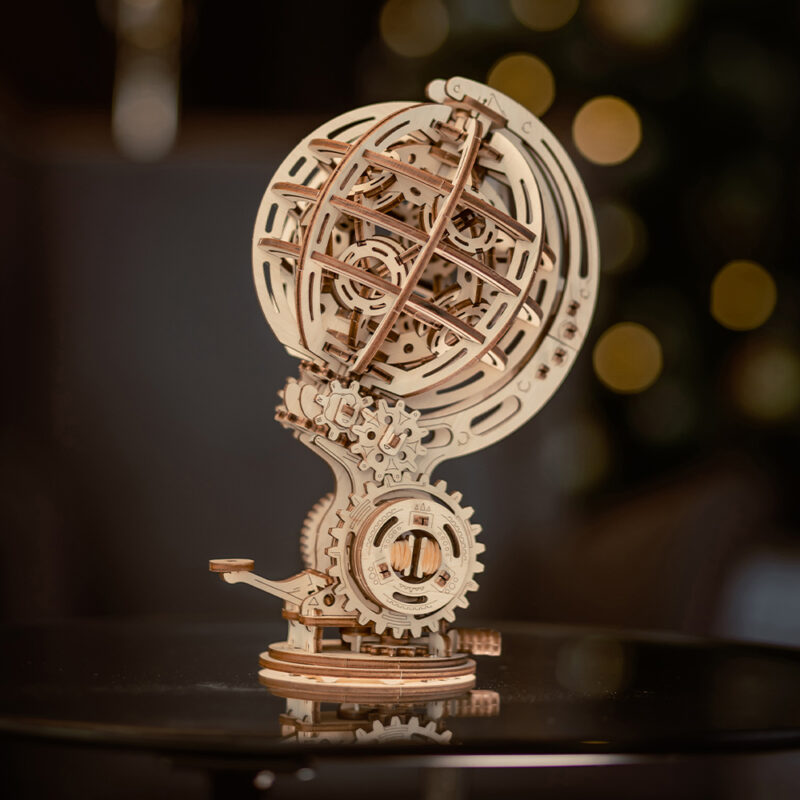
If the kit is intended for an adult, other factors come into play. The pleasure lies not only in completing the model but in the process itself. Locomotives, retro cars, tractors, mechanical clocks, globes and structures with real movement work very well here. These are projects that require attention, but precisely for this reason, they offer a much more engaging sense of progress.
For a gift, the best choice is often one that combines a wow factor with accessibility. A model that is beautiful to look at, can be assembled without glue, and has a decorative final result has a clear advantage: it doesn't stay closed in a box after the first use. It becomes part of the home, the study, or the bedroom.
The most interesting categories to consider
Among the most requested kits are mechanical wooden models. They are popular because they go beyond aesthetics. Once assembled, they show gears, levers, spring movements, or small transmission systems. This makes them ideal for those who want a creative activity that also has an engineering component, but without becoming too technical.
Right after that are vehicles. Trains, vintage cars, trucks, and tractors have a cross-cutting appeal: they attract adults for the constructive detail and young people for the dynamic component. These kits also work well as a first approach to advanced modeling, because the subject is familiar and the construction proceeds in easy-to-understand blocks.
Another very strong category is decorative 3D puzzles. Here, the value shifts a bit more towards design. Globes, architectural elements, animals, and display objects have less technical assembly but a notable aesthetic impact. They are perfect for those seeking a relaxing pastime with an elegant result.
Finally, there are educational kits for children and teenagers. In this case, the model's ability to teach something while entertaining is very important. The project doesn't need to be complex. It just needs to show how parts connect, how a three-dimensional form is created, and how rewarding it is to complete something with one's own hands.
Best glue-free construction kits for children
For the little ones, the best glue-free construction kits are those that reduce frustration and increase the sense of achievement. This means well-numbered pieces, intuitive interlocking, and a visible result already in the early stages of assembly. If the child sees the model taking shape early on, they stay motivated until the end.
It is also useful to choose subjects with a strong visual identity. A dinosaur, an animal, a small vehicle, or a fun structure help keep attention high. Additionally, after assembly, the kit can become an object to keep in the room, to show off, or to use as a starting point for other games.
An often underestimated aspect is shared construction. Some kits are perfect for a parent-child afternoon, because they allow alternating simple phases and steps where the adult can lend a hand. This makes them more than a game: they become quality offline time, with a concrete result at the end.
Best glue-free construction kits for adults
For an adult, the criteria change. The assembly must be smooth, yes, but also rich enough not to seem trivial. The most appreciated models are those that offer a balanced challenge: no glue, no special tools, but a structure that is sufficiently articulated to keep attention alive for several hours.
Mechanical wooden kits stand out precisely for this reason. They offer precision, manual satisfaction, and a final result that often actually moves. This is where glue-free modeling shows its full value: accessible even to those with no experience, yet capable of providing an authentic feeling of technical construction.
Those looking for a decorative object can aim for display models with a strong visual personality. Those who love understanding how gears work will find dynamic projects more interesting. Neither choice is absolutely better. It depends on what you want to achieve: relaxation, challenge, decor, or pure mechanical curiosity.
The concrete advantages of glue-free assembly
The first advantage is simplicity. No extra materials are needed, the table doesn't get dirty, and there's no drying time to wait for. This makes the experience more immediate and much more suitable for home use, especially if the kit is assembled in the living room, kitchen, or with children.
Then there's a benefit related to precision. In well-designed kits, the interlocking is an integral part of the experience. Each piece has a clear function and invites you to observe, try, and correct. It's a type of construction that stimulates attention and logic without turning into a complicated activity.
Finally, the glue-free aspect is reassuring. For beginners, knowing that no technical skills are needed lowers the entry barrier. For enthusiasts, it means being able to start right away and focus on the pleasure of assembly, not on preparation.
When to choose a simple kit and when to choose an advanced one
A simple kit is the right choice if the recipient is a beginner, if you want a short activity, or if the main goal is relaxation. In these cases, the smoothness of assembly matters more than the final complexity of the model.
An advanced kit is worthwhile when you want to dedicate time to the project and when the final result needs to have a stronger character. A model with mechanisms, many details, or moving parts requires more patience but also delivers greater satisfaction. The only real mistake is choosing a level that's too high for the first attempt. It's better to start well and want to increase the difficulty than to stop halfway.
For this reason, in a specialized catalog like Puzzle3D's, variety makes the difference. It allows you to find the right kit not only by age but also by style, available time, and the type of experience you want to have.
What to check before purchasing
Before choosing, it's worth checking three things: recommended age, number of pieces, and type of model. These are simple indicators, but they immediately help you understand whether the kit will be engaging or frustrating. The presence of moving parts or mechanical functions can also greatly guide the choice.
It's also worth considering the context in which it will be used. If it's a gift for a family, a more accessible and shareable model is better. If it's a personal purchase for someone who enjoys building at a leisurely pace, you can be more daring. And if the final result will be on display, then design matters as much as assembly.
The best glue-free construction kits are not necessarily the most complex ones, but those that manage to combine precision, manual pleasure, and a final result to be proud of. When that happens, the kit is no longer just a pastime: it becomes a small personal project, to be experienced piece by piece.