
Parenting
Modeling guide for beginners: where to start

May
There’s a moment when you open the box, look at the pieces, and think two things at once: nice, but where do I start? That’s exactly where a good beginner’s guide to model building makes the difference. You don’t need experience, nor a workbench: you need the right kit, a bit of time, and the pleasure of building something with your hands.
Model building, especially the kind designed for simple and clean assembly, is one of those hobbies that balances concentration, creativity, and final satisfaction. For an adult, it can be a concrete way to disconnect from screens. For a family, it’s a shared activity that also leaves something beautiful to look at. For someone looking for a gift, it’s a choice that doesn’t end as soon as the package is opened.
Beginner’s Guide to Model Building: How to Choose Your First Kit
The most common mistake isn’t messing up a joint. It’s starting with a model that’s too complicated. Beginners often tend to be drawn to the most spectacular model, maybe full of details or with a complex mechanism. The problem isn’t ambition, but the balance between difficulty and the pleasure of assembly.
To start off right, it’s best to choose a kit with three clear features: readable instructions, a manageable number of pieces, and glue-free assembly. Pre-cut wooden models are especially suitable because they offer a tidy, clean, and intuitive experience. Every piece has its place, the material is pleasant to touch, and no special equipment is needed.
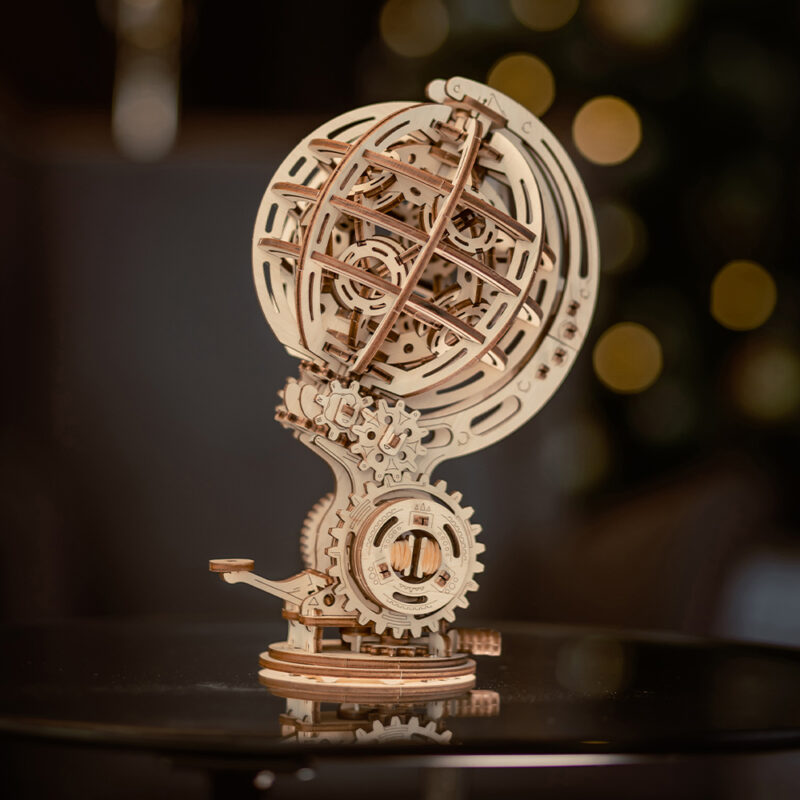
The theme also matters. If you really like the subject, motivation stays high until the last joint. A train, a retro car, a dinosaur, or a small gear mechanism aren’t just categories: they’re different ways to experience assembly. Those who love the final decorative effect can go for globes or display models. Those who also want movement will find more rewarding working mechanical kits.
Simple or mechanical right away?
It depends on who is building. For an adult beginner with good manual dexterity, an easy mechanical model can already be a sensible choice, especially if the assembly system is designed without glue and with precise joints. For a child or someone who has never done model building, it's better to start with a more straightforward structure.
The practical rule is this: the first kit should teach the rhythm of assembly, not test your patience. If the assembly flows smoothly, the desire to move on to a more complex model will come naturally.
What You Really Need to Get Started
Much less than you think. One of the reasons wooden model building is so accessible is precisely this: it eliminates much of the technical preparation that often discourages beginners. No glues to measure, no paints to manage, no professional tools to buy before even knowing if you really like the hobby.
All you need is a stable surface, good light, and a bit of calm. Having a small container nearby to separate already detached pieces can be useful, but it’s not mandatory. Also, reading all the instructions before starting helps much more than any accessory. It sounds like a trivial tip, but it avoids half of the typical mistakes.
If the kit is well-designed, the assembly itself guides your hand. This is an important difference compared to more technical forms of model building: here, the entry is gentler, but the satisfaction remains high. That’s why many start out of curiosity and continue for pleasure.
The Most Common Mistakes Beginners Make
Rushing is the first obstacle. Popping out all the pieces at once, skipping steps, or forcing a joint with a “it’ll fit anyway” attitude almost always leads to a worse result. Model building rewards calm precision, not speed.
The second mistake is ignoring the logic of the material. Wood is sturdy, but it needs to be handled with care. If a part offers too much resistance, it’s usually not the piece that’s wrong: it’s the orientation. Stopping for ten seconds to check the correct direction is worth much more than insisting.
Then there’s a less obvious mistake: choosing model building as an activity to do “whenever,” perhaps amid countless interruptions. In reality, it gives its best when you dedicate a specific time to it. Even half an hour, but truly focused. That’s how assembly becomes relaxing instead of distracting.
How Much Time Does It Take?
Again, it depends on the kit and the person. Some models can be completed in a single session, others require multiple moments. For a beginner, it's better not to evaluate time solely in terms of reaching the result. The beauty also lies in the process: observing the details, seeing the shape take form, understanding how a mechanism is built piece by piece.
When the model is well thought out, time doesn’t feel heavy. On the contrary, it becomes part of the product’s value. You’re not just buying an object, but a concrete, hands-on, and intelligent experience.
How to Tell if a Kit is Suitable for Children or Adults
It's not enough to look at the subject. A dinosaur can be very simple or very complex. A vehicle might seem suitable for an adult but have a surprisingly straightforward assembly. That's why it's useful to look at three elements: recommended age, complexity of the mechanism, and number of pieces.
For the children from 7 years old and up work best with kits that have a clear and progressive structure, where each step immediately delivers a small visible result. This keeps attention high and makes the activity more rewarding. The presence of an adult can turn assembly into a shared moment, especially with more detailed models.
For adults, however, the boundary is not so much age as it is the goal. Some seek relaxation and prefer accessible models. Others want a greater constructive challenge, perhaps with gears, wheels, levers, or moving parts. No choice is more right than another: only the type of experience changes.
Why wood modeling appeals even to those who don’t consider themselves ‘gifted’
Because it is concrete. It doesn’t require artistic talent and doesn’t demand advanced technical skills. It guides you step by step and leaves something visible, tangible, often even functional. This greatly lowers the barrier to entry.
Plus, wood has an advantage you notice right away: it conveys quality and naturalness. The assembly is more pleasant, the finished object has an authentic decorative presence, and the entire experience feels less disposable. In a home full of digital stimuli, building a mechanical model without batteries has a very concrete appeal.
For many people, it's precisely this combination that makes the difference: hands-on work, concentration, sustainability, and the final result. It's no surprise that a well-chosen kit is often bought both for oneself and as a gift.
Beginner modeling guide: which models offer the most satisfaction
If the goal is to start off on the right foot, the best models are those that offer a balance between simplicity and character. A small wooden vehicle, a jointed animal, a decorative gear, or a basic mechanical model are excellent examples. They have enough personality to excite, but not so much complexity as to discourage.
Models with movement are often the most memorable. Seeing a wheel turn, a mechanism click, or a dynamic structure take shape adds immediate gratification. However, a small caution applies here: for a first purchase, it's better to choose an introductory version, not the most advanced kit in the category.
Even structural 3D puzzles are a very effective entry point. They train observation and logic, get you used to following a sequence, and build confidence. After one or two models of this type, moving on to a mechanical kit feels much more natural.
Those seeking an accessible and rewarding first approach often find in Puzzle3D kits a particularly suitable formula: natural materials, glue-free assembly, and models designed to combine fun, aesthetics, and constructive discovery.
When modeling becomes a happy habit
It almost always happens after the first successful model. Not because everything is perfect, but because it changes how you view the activity. It’s no longer “let’s see if I can do it,” but “what do I build next?” And that’s when modeling stops being just an occasional pastime and becomes a personal space of calm, focus, and creativity.
For some, it remains a weekend hobby. For others, it enters the evening routine, replacing the screen. For a family, it can become a small shared ritual. The beauty is precisely this: it doesn't impose a single way to experience it.
If you're choosing your first kit, don't look for the most complex model. Look for one that invites you to start without pressure, with genuine curiosity, and with the promise of a result you'll want to look at even after you've finished assembling it. From there, the rest comes piece by piece.