
Parenting
Working wooden mechanical models: how to choose them
Apr
There is a clear difference between a simple pastime and an object that truly engages you: the moment when, after the last piece is fitted, the gears start moving. That is where working wooden mechanical models reveal their true charm. They are not just beautiful to look at. You build them with your hands, understand them piece by piece, and once completed, they actually do something.
For those seeking a creative activity to do at home, an original gift, or a smart alternative to electronic games, these kits have a clear advantage: they combine hands-on work, concentration, and final satisfaction into a single experience. And they do so with natural materials, clean assembly, and real mechanisms, without batteries and without the need for special tools.
Why working wooden mechanical models are so popular
The success of these models is not just about aesthetics. Sure, wood has a warm and decorative visual impact, but the main point is something else: the assembly is not passive. Every piece has a function, every gear works together with the others, every lever or rubber band contributes to the final movement.
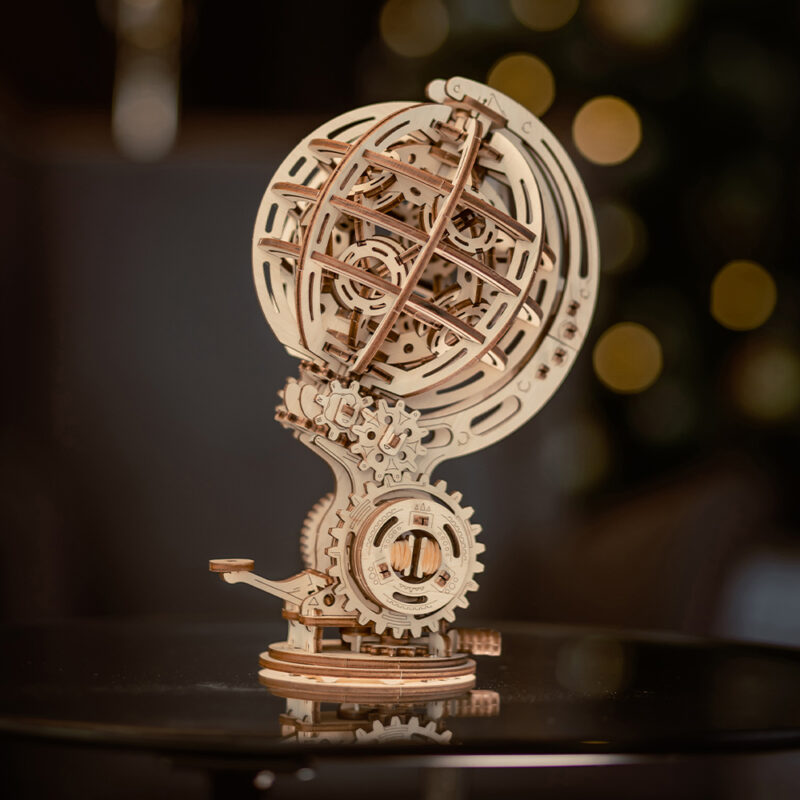
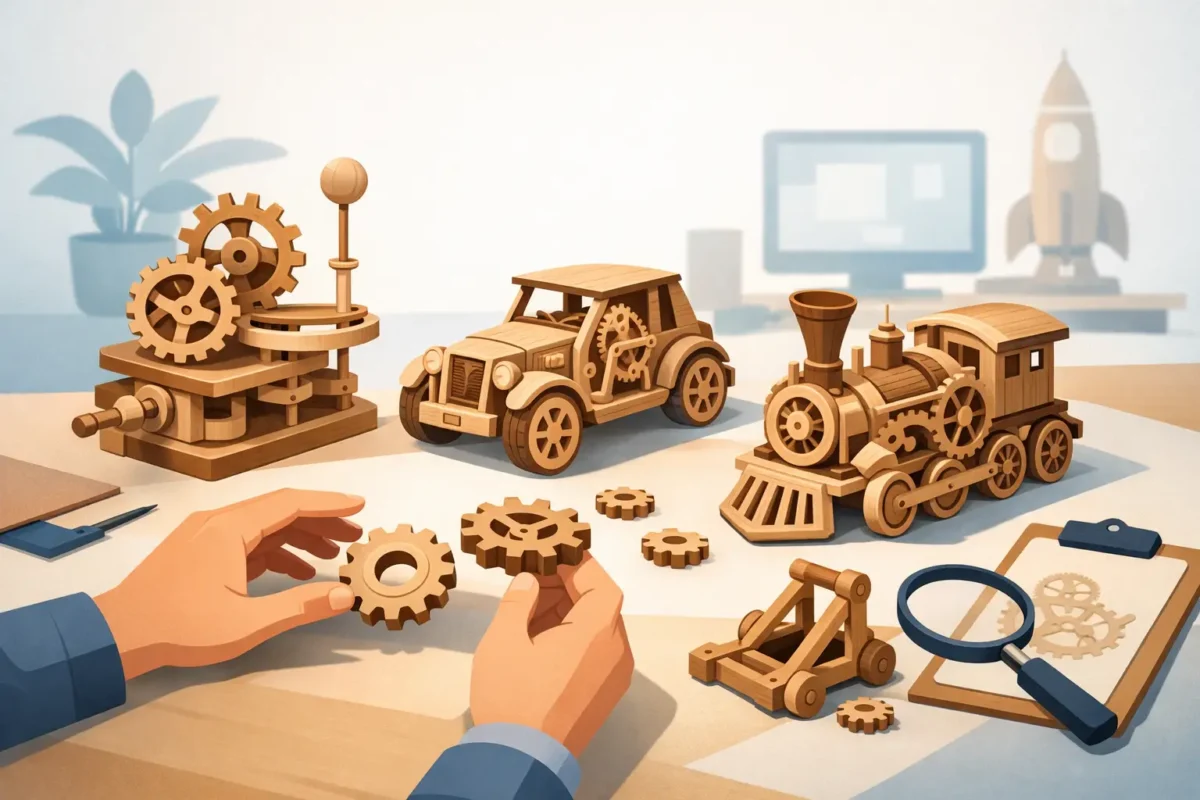
This makes the experience much richer compared to a ready-made object. A tractor that moves forward, a train with a mechanical transmission, a retro car with moving details, or a planetary gear system are not just models to display. They are small machines to understand and bring to life.
For the children aged 7 and up, always with an age-appropriate kit, become a concrete way to develop logic, patience, and coordination. For adults, on the other hand, they often represent a moment of active break: you step away from screens, work with your hands, and rediscover the pleasure of building something precise and functional.
What truly makes a kit worthwhile
Not all wooden models offer the same experience. Some focus mainly on the decorative aspect, others on technical complexity. The right choice depends on who is assembling it, the time available, and the type of satisfaction you are looking for.
A good kit must first and foremost be well-designed. The pieces must come out easily, the joints must be precise, and the instructions must guide the assembly without causing frustration. When the project is well thought out, the model flows. It requires attention, certainly, but it does not become a constant struggle with unreliable components.
The mechanics also matter a lot. A working model must offer credible and stable movement. It is not enough for a wheel to spin for a few seconds. The beauty is seeing a system that transmits motion clearly, cleanly, and satisfyingly. It is precisely this step that transforms a 3D puzzle into a creative engineering experience.
Then there is the topic of materials. Precision-cut wood gives a different feel compared to plastic: more natural, more pleasant to touch, more suitable for staying on display on a shelf or desk. For many families, this is an important value, because it adds a sustainable component and reduces the disposable toy effect.
How to choose the right model
The first question to ask is simple: who will actually build it? If the recipient is a beginner, it is better to start with an accessible model, with a manageable number of pieces and clear mechanics. A simple vehicle or a small gear system can provide immediate satisfaction without discouraging.
If instead the kit is intended for a modeling enthusiast or someone who enjoys longer projects, then it makes sense to level up. More complex models require more time, more precision, and a certain consistency, but in return they offer richer details and a decidedly spectacular final result.
The theme of the model also makes a difference. Trains and tractors are very popular with those who love obvious mechanical movement. Retro cars attract those looking for an elegant as well as functional object. Dinosaurs and educational puzzles, on the other hand, appeal more to a family audience, especially when you want to combine play and learning. Planetary gears, finally, are perfect for those who appreciate the more technical side and want to observe up close how motion is transmitted.
It is also worth considering the assembly time. A kit that can be completed in one or two hours is ideal as a weekend activity or as a gift to open and use right away. A more challenging model is suitable for those who want a project to take on calmly, perhaps over multiple sessions.
Assembly without glue: a concrete advantage
One of the most appreciated aspects is assembly without glue. It is not just a convenience. It changes the very type of experience.
Without glue, you work more cleanly, reduce downtime, and make the kit much more accessible even to those with no experience. For parents, it is a reassuring detail, because it means less mess and more autonomy for the kids, always respecting the recommended age. For someone giving a gift, on the other hand, it is a practical guarantee: the recipient can start right away, without having to look for additional materials.
This does not mean that assembly is trivial. The joints still require attention and precision. But that is precisely the beauty: the difficulty is constructive, not unnecessarily complicated. You feel like you are doing something accurate, not fighting with an unintuitive kit.
A gift that doesn’t end up in a drawer
Many gifts make a good impression for just a few minutes. Then they lose interest. Working wooden mechanical models, on the other hand, have more lasting value because they offer three different moments of pleasure.
The first is the initial surprise when you discover the subject of the kit. The second is the assembly, which often becomes the most memorable part. The third comes at the end, when the model remains as an object to display, show off, and set in motion again.
For a birthday, Christmas, or a special occasion, they are a much more personal choice compared to standard gifts. They communicate attention, taste, and a desire to offer an experience, not just a product. And they have a rare quality: they appeal both to those who love to build and to those looking for a beautiful object to keep at home.
For families, hobbyists, and the curious: there is no single use
One of the best qualities of these kits is their versatility. In a family, they can become a shared activity, useful for spending time together without screens. In this case, it's best to choose clear models with well-distributed steps, so as to involve multiple people without creating confusion.
For the adult hobbyist, on the other hand, the kit is often a small personal ritual. It is assembled calmly, the mechanisms are observed, and the precision of the design is appreciated. Here, the challenge level can be higher because the pleasure also lies in the complexity.
Then there are those who approach this world out of pure curiosity. Maybe they have never tried model building, but they are looking for something more stimulating than any ordinary pastime. In these cases, the right approach is to start with a subject they are truly passionate about. When the theme appeals, the motivation during assembly changes completely.
What to evaluate before purchasing
Before choosing, it's worth carefully looking at three elements: difficulty level, recommended age, and type of mechanical movement. These are simple factors, but they greatly impact final satisfaction.
A model that is too difficult for the recipient risks remaining unfinished. One that is too simple, on the contrary, can disappoint someone looking for a richer challenge. The mechanism should also be considered: some prefer vehicles that actually move, while others find visible gears or articulated structures more fascinating.
Finally, context matters. If the kit is intended for a child, an engaging but accessible project is needed. If it is for an adult, you can focus more on design, detail, and complexity. If it is a gift, it is useful to choose a model that has an immediate strong visual impact and a clear function. In a well-organized catalog, like that of Puzzle3D, this makes the choice much easier.
The value that remains after assembly
There is a reason why these models are increasingly chosen by those looking for something different. They don't just offer entertainment. They leave a concrete feeling of time well spent.
You assemble, you learn, you observe how each part contributes to the result. And in the end, an object remains that didn't come out of a box ready-made: it passed through the hands of the person who built it. This changes the relationship with the product, making it more personal and much more memorable.
If you are looking for a creative activity, a smart gift idea, or a simple way to bring a bit of ingenuity and craftsmanship back into everyday life, starting with a well-chosen model is often the best decision. The right kit is all it takes to turn a free afternoon into something that continues to be admired even after the last piece is assembled.