
Parenting
Wooden mechanical puzzle guide: how to choose
May
Choosing a wooden mechanical puzzle isn't just about picking a simple box to assemble. It means deciding what kind of experience you want to have – relaxing, creative, educational, or truly challenging. This guide to wooden mechanical puzzles is designed to help you understand which model makes sense for you, for a curious child, or for a gift that truly leaves a mark.
People love 3D wooden mechanical puzzles because they combine several things together. They are satisfying to build, rewarding to see finished, and often surprise you when they start moving with gears, levers, wheels, or small functional systems. Plus, they appeal to those seeking an offline pastime with natural materials, no batteries, no glue, and no special tools. For many families and passionate adults, this is exactly where the value lies.
Why a guide to wooden mechanical puzzles is truly useful
At first glance, many models look similar. All wooden, all to be assembled, all very scenic. However, the difference between a spot-on purchase and a less suitable one lies in the details: number of pieces, required precision, quality of the final movement, recommended age, build time, and the type of satisfaction the kit provides.
A mechanical tractor, for example, doesn't offer the same experience as a wall-mounted globe or a planetary gear. The first often focuses on the pleasure of movement and the wow effect. The second adds a strong decorative component. The third is perfect for those who love seeing the logic of mechanisms take shape piece by piece. There is no absolute best model. There is the right model for the right person.
Wooden mechanical puzzle guide: where to start
The first criterion is the level of familiarity with this type of kit. If it's the first assembly, it's best to choose an accessible model with clear instructions and not overly complex mechanics. Otherwise, the risk is turning a pleasant moment into an excessive test of patience.
For children from 7 years old For beginners, models with fewer pieces and an intuitive structure work well. Animals, small vehicles, or educational puzzles are often a smart start. They immediately provide the satisfaction of the result and help build confidence with interlocking, manual precision, and reading instructions.
Adults or hobbyists looking for something more engaging can lean towards locomotives, retro cars, articulated tractors, mechanical dinosaurs, or gear systems. Here, the pleasure isn't just building the object, but understanding how each part contributes to the final movement. It's a deeper type of entertainment, requiring concentration but offering great rewards.
Age, manual dexterity, and available time
The recommended age is useful, but not sufficient on its own. Two people of the same age can have very different levels of patience and manual dexterity. For this reason, it's also worth considering the time you want to dedicate to assembly.
A short kit is ideal for a family afternoon or for a gift you want to start right away without hesitation. A more complex model, on the other hand, is perfect for those who enjoy building slowly, perhaps over multiple sessions, turning the assembly into a true relaxation ritual. If the recipient tends to abandon overly long projects, it's better to avoid the denser kits. If they love creative DIY, then the complexity itself can become the strong point.
The appeal of working mechanisms
Not all 3D wooden puzzles offer the same interaction. Some are primarily decorative. Others, once completed, actually move. This is where mechanical puzzles make the difference.
Wheels that turn, levers that activate, gear transmissions, articulated elements, and small manual animations bring the model to life. For a child, this means learning by observing cause and effect. For an adult, it means rediscovering the tangible pleasure of a construction that doesn't just sit still on a shelf like a simple knick-knack. If you're looking for wonder, choose a model with obvious movement. If you're looking for clean design, even a static but well-detailed subject can be the most suitable choice.
How to choose the right subject
The subject isn't just an aesthetic matter. It determines the type of emotional and practical involvement the puzzle will have during and after assembly.
Vehicles like trains, tractors, and retro cars are perfect for those who love visible mechanics. They have a strong presence, often include wheels, transmissions, and details that give character to the model. Articulated dinosaurs and animals, on the other hand, appeal greatly to children, but not only to them. They have an immediate playful side and are often beautiful to display.
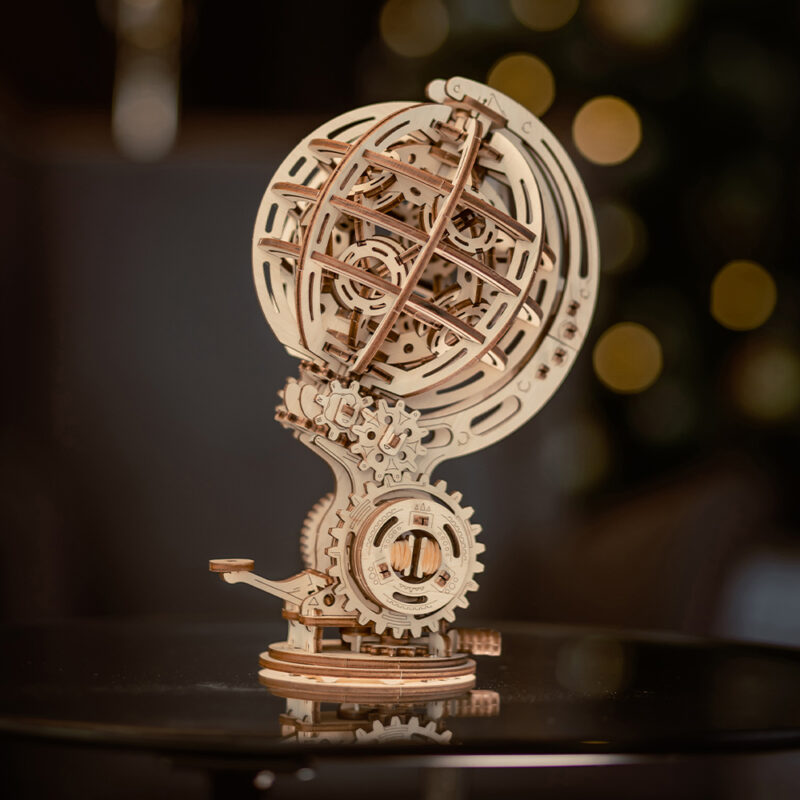
Planetary gears and more technical models appeal to those seeking a construction that makes you think. Here, the beauty lies in seeing order emerge from complexity. Wall-mounted wooden globes or other decorative objects, instead, have a double advantage: they offer a hands-on experience and then remain in the home as a decorative element, not just as a finished toy.
If you're buying a gift, ask yourself one very practical question: will the recipient enjoy the assembly process more or the final result to display? The answer changes everything.
Natural materials and glue-free assembly
One of the reasons these kits are winning over families and enthusiasts is their construction simplicity. The wood is pleasant to the touch, warm, natural, and visually much more welcoming than plastic. It integrates better into the home, especially if the model remains visible on a shelf, desk, or in a bedroom.
Glue-free assembly is another concrete advantage. It reduces mess, makes the experience cleaner and more accessible, and allows you to focus on the interlocking, not on managing extra tools or materials. This matters a lot both for parents and for those seeking a relaxing hobby to start right away. It doesn't mean every assembly is extremely easy. It does mean, however, that the entry barrier is low and the experience is more straightforward.
When a mechanical puzzle makes a good gift
A wooden mechanical puzzle works very well as a gift because it avoids two common problems: being impersonal or becoming useless after a few minutes. Here, instead, there is an experience to be had and an object to keep.
For a child, it's a concrete way to train attention, coordination, and patience without screens. For an adult, it's a smart gift, capable of combining relaxation, hands-on activity, and final satisfaction. For a family, it's also a shared activity, especially if the difficulty level is well chosen.
The only thing to be careful about is not to be guided solely by the visual effect of the box. A very complex model can be fascinating at first glance, but if it's not suitable for the person, it risks remaining unfinished. A well-calibrated kit, on the other hand, is built with pleasure and remembered better. This is what makes the gift successful.
Common mistakes to avoid
The first mistake is confusing beauty and accessibility. Some models are magnificent but require a lot of precision. If the recipient is a complete beginner, it's better to start with something more immediate.
The second mistake is underestimating the time. A mechanical puzzle is not a five-minute pastime. This is precisely its charm, but it must be considered. If you're looking for a short activity, it's better to choose slimmer kits.
The third mistake is not thinking about the final space. Some models have significant dimensions or become true decorative elements. Great, if there's the right place. Less great if they end up in a box because you don't know where to put them.
Who they are really suitable for
These puzzles are suitable for different audiences, but for different reasons. Children find discovery and intelligent play in them. Parents appreciate the educational value, the use of natural materials, and the fact that no batteries are needed. Adults see a creative hobby that relaxes and engages the mind in the right way. Those looking for a gift, instead, find something less obvious than a ready-to-use object.
This is also what makes a specialized catalog like Puzzle3D's interesting: it doesn't offer just one type of experience, but a range of models from the simple and family-friendly kit to the more detailed project for those who want a rewarding and decorative construction.
How to know if you’ve found the right model
The right model is not necessarily the largest or the most elaborate. It's the one that manages to hold together three elements: the pleasure of assembly, the satisfaction of the result, and the suitability for the person who will build it.
If you can already imagine the moment the box will be opened, the pieces separated with curiosity, and the mechanism tested with a smile as soon as it's finished, you are probably on the right track. And this is the beauty of wooden mechanical puzzles: they don't just give an object, but a different time, more concrete, calmer, and much more memorable.