
Parenting
Montessori wooden educational puzzles: how to choose them
Apr
Some differences are immediately obvious: a game left on the couch after ten minutes, and an activity that truly engages hands, eyes, and attention. Montessori wooden educational puzzles are loved precisely for this reason. They don't make noise, they don't flash, they don't need batteries. They put the child at the center of the experience and turn a simple gesture—fitting, sorting, recognizing—into a concrete exercise in independence, concentration, and logic.
For a family looking for smarter alternatives to electronic games, this category has a very clear advantage: it combines natural material, tactile experience, and progressive learning. But not all wooden puzzles are truly suitable for a Montessori approach. And reading “educational” on the package isn't enough to make a good choice.
Why Montessori wooden educational puzzles really work
The strength isn't just the wood. It's the way the child interacts with the object. A good Montessori puzzle presents a clear task, a readable difficulty level, and an almost natural error correction. If a piece doesn't fit, no adult needs to say what to do: the child observes, tries, compares, and repeats.
This aspect matters more than it seems. When the game is well-constructed, the child doesn't passively undergo the activity but guides it. They touch, rotate, match shapes and sizes, developing fine coordination and problem-solving skills without perceiving it all as a “lesson.”.
Wood adds another level of quality. It's stable, pleasant to the touch, resistant to daily use, and visually less distracting than many highly colorful plastic materials. Plus, it conveys a concrete sense of a real object, not disposable. For those who appreciate durable and sustainable products, it's a consistent choice even at home.
What makes a wooden puzzle Montessori
Here it's best to be clear. “Montessori” doesn't simply mean natural, minimal, or beige. A Montessori wooden educational puzzle, to be truly close to this method, should meet some practical criteria.
First of all, the function must be immediate. The child should understand what to do almost on their own. A puzzle with geometric shapes, recognizable animals, clearly distinguishable letters, or size-based fits works better than a product that's too decorative or confusing.
Then there's graduality. If the level is too easy, interest drops quickly. If it's too difficult, frustration sets in. The right model offers a realistic challenge for age and skills, leaving room for improvement without becoming an obstacle.
Visual order is also important. A clean base, solid pieces, readable colors, and not too many details help focus. The goal isn't to amaze with special effects, but to promote concentration.
How to choose the right model based on age
The indicated age is a good starting point, but it's not the only criterion. Every child has their own pace, specific interests, and a different relationship with manual skills.
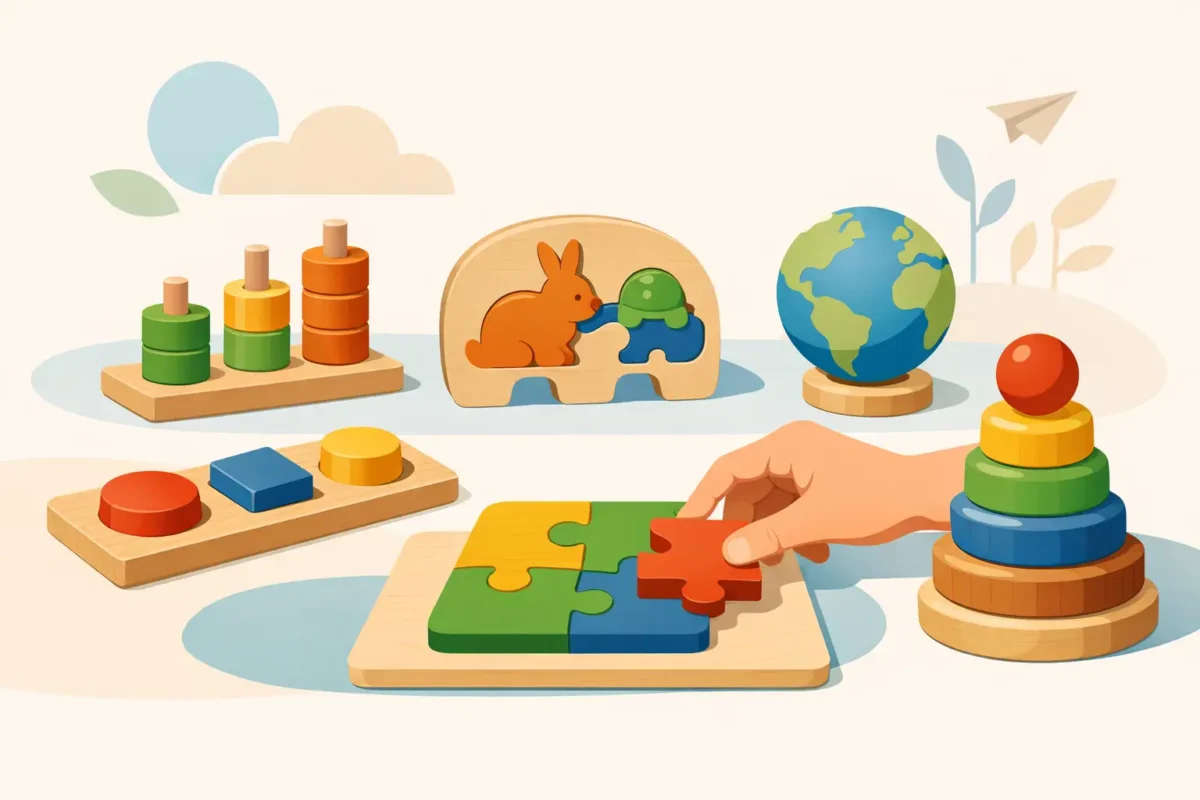
Between ages 2 and 4, simple knob puzzles with large shapes and very recognizable subjects work well. Animals, vehicles, fruit, and basic figures help with the association between word, image, and shape. At this stage, the priority is grip, hand-eye coordination, and visual recognition.
From ages 4 to 6, complexity can increase. Layer puzzles, logical sequences, numbers, the alphabet, and early classification activities come into play. Here, the child doesn't just insert a piece into the correct space but begins to grasp relationships, order, and progression.
From ages 6 or 7 and up, richer possibilities open up. Wooden educational puzzles with maps, simplified anatomy, basic mechanical systems, clocks, calendars, and more articulated constructions can offer greater satisfaction. At this age, educational value grows when the game requires observation and patience, without losing clarity.
For this reason, in a well-constructed catalog, the division by age group is useful, but even more useful is understanding what type of skill you want to train.
What skills they really develop
People often talk about “cognitive development” in a generic way. It's better to be concrete. Well-designed wooden puzzles primarily work on fine coordination, spatial orientation, visual discrimination, memory, and concentration.
A shape sorter trains precision of movement and spatial reading. A puzzle with letters or numbers fosters familiarity with symbols and sequences. A layered or categorical model stimulates logic and classification. When a child repeats the activity, they aren't simply redoing the same game: they are consolidating a method of observation.
Then there is a benefit that many parents notice right away, even without naming it in these terms: time slows down. The child stays on the activity, focuses, and seeks the solution. In a home environment full of rapid stimuli, this value is enormous.
Materials, finishes, and safety: what to check
When buying a wooden puzzle for children, build quality is not a detail. It makes a difference in daily use and in the peace of mind of the buyer.
Surfaces must be smooth, well-sanded, and free of sharp edges. Pieces must be sturdy and proportionate to the age. For the youngest children, it's best to avoid overly small components. Paints also deserve attention: safe finishes, suitable for children's use and with minimal or no odor, are preferable.
Another useful point is the stability of the base. If the base flexes easily or the fits are imprecise, the experience becomes less rewarding. A good wooden puzzle must immediately convey a feeling of precision: the piece fits well, the action is clean, the result is clear.
For those who love long-lasting toys, wood has an obvious practical advantage. It holds up better than many cheap materials, keeps well, and also maintains aesthetic value. It's not uncommon for it to remain nice to look at on a shelf or in a bedroom, even when not in use.
Simple puzzles or more structured models?
It depends on who receives it and how it will be used. If the goal is to introduce a young child to independent play, the best choice is almost always a simple, intuitive, and immediate puzzle. Too much complexity at the start risks dampening interest.
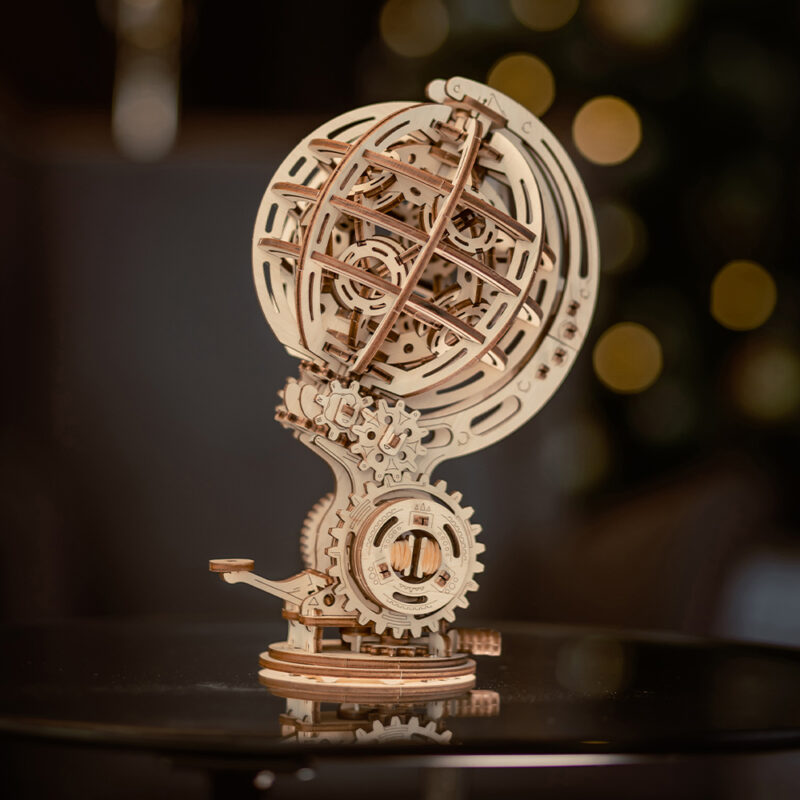
If instead you are looking for a more engaging activity for children already accustomed to building, ordering, and following logic, you can level up. In these cases, products that combine educational value and the pleasure of assembly, with an approach closer to construction than simple fitting, also become interesting.
This is where a specialized brand like Puzzle3D effectively meets the needs of families and enthusiasts: offering wooden experiences that are not just pastimes, but intelligent, hands-on activities capable of leaving something behind even after assembly.
When they are a good gift idea
Many gifts make a scene on the first day and then disappear. Montessori educational wooden puzzles have a more concrete advantage: they remain useful. They are suitable for birthdays, school occasions, parties, and thoughtful small gifts, especially when you want to avoid something impersonal.
They work well because they speak to multiple needs at once. For the child, they are play and discovery. For parents, they are order, quality materials, and educational value. For the giver, they are a choice that communicates care, not a hasty purchase.
Here too, the level of difficulty matters. A gift that is too advanced for the age can be perceived as inaccessible. One that is too simple risks not lasting long. The best choice is one that leaves room for growth but offers satisfaction from the very first use.
How to truly integrate them into the home routine
A good puzzle doesn't perform at its best if it's thrown into a basket full of random toys. To make the most of it, you need very little: an organized space, a few items available, and a quiet moment during the day.
When a child can pick up the game on their own, use it, and put it away easily, their independence grows. This is one of the reasons why wooden puzzles work so well at home, not just in educational settings. They require no complex preparation, don't depend on screens, and don't tire with excessive stimuli.
It's also better to rotate the models instead of leaving them all visible at once. A more essential selection keeps curiosity high and reduces clutter. You don't need a perfect playroom. You need a sensible selection.
The final criterion for choosing well
If you're considering a purchase, the right question isn't “does this puzzle teach something?” Almost all of them do, to some extent. The useful question is another: does it truly invite the child to do it on their own, with pleasure and concentration?
When the answer is yes, the product has already hit the mark. The best educational wooden puzzle isn't the loudest, flashiest, or most crowded with promises. It's the one that can turn a simple action into a concrete discovery experience, hand over hand.
If you choose with this criterion, it will be easier to bring home a game that's beautiful to look at, pleasant to use, and capable of accompanying free time with more intelligence and fewer distractions.