

Parenting
Why is the puzzle a symbol of autism?

Jan
Why is the puzzle a symbol of autism?
Because the puzzle is the symbol of autism? Represented a “mystery” to be solved. Discover the critiques and new inclusive symbols to really understand neurodiversity.
The origins of the puzzle symbol in autism
The symbol of the puzzles for autism became popular in the 1990s. It has been widely adopted by large organizations to raise public awareness.
Birth and intent of the symbol
The image was created in 1963 by the National Autistic Society in the United Kingdom. The original logo depicted a crying child on a puzzle tile, representing the condition as “children trapped in their own world.”.
The initial intent was to communicate the complexity and mysteriousness of autism. It was intended to draw attention to a condition that was poorly understood at the time. The goal was to raise funds for research and support.
The representation of autism as an “enigma” or “incompleteness”
The puzzle metaphor suggested that autism was a mystery to be solved. Each tile represented the complexity of the spectrum. The idea of a “missing piece” implied that something was broken or incomplete.
This narrative has dominated for decades, influencing public perception. It led to research focused on “cause” and “cure.” The focus was there, rather than on understanding and acceptance.
Why the puzzle symbol is criticized by the autistic community
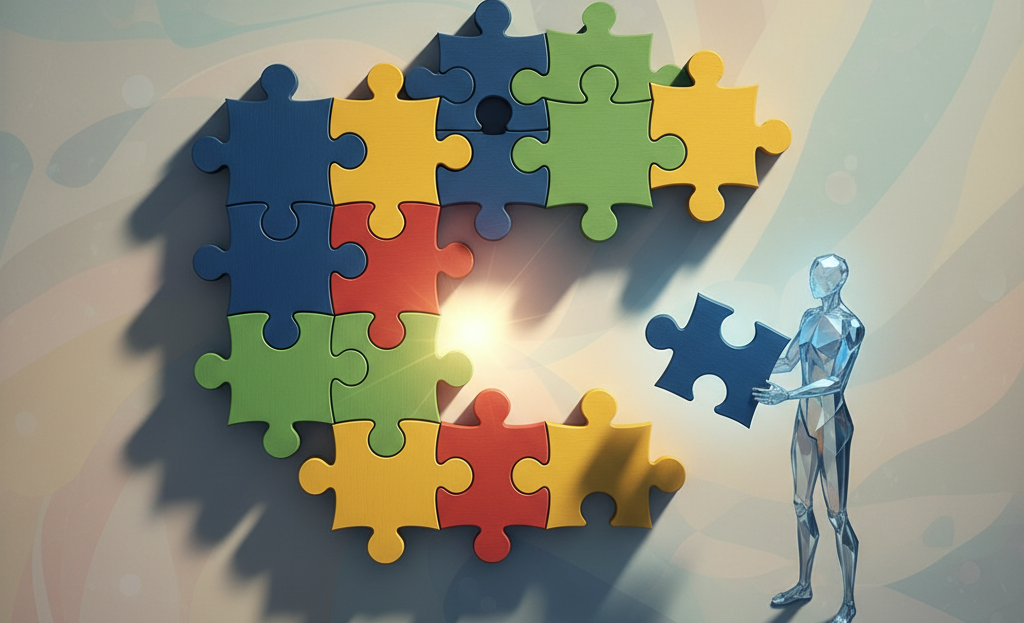
Many autistic adults and neurodiversity advocates today reject the puzzle symbol. They consider it harmful and unrepresentative of their experience.
The negative implications of the “missing piece”
The image of the missing piece is particularly offensive. It conveys the idea that autistic people are incomplete or defective, needing to be “fixed.” Think about how it feels if someone is always trying to fix you instead of understanding you.
This pathologizing view ignores the strengths, talents, and whole identity of individuals on the spectrum. It reduces a person to a problem to be solved, not a human being to be understood.
Association with controversial organizations and pathologizing views
The symbol is closely associated with organizations such as Autism Speaks. These are often criticized for promoting narratives of suffering and advocating practices such as compliance therapies.
The autistic community challenges the absence of autistic voices in such organizations. It stresses the importance of authentic representation, similar to the principle of inclusion in the **ENEA communication** for accessibility.
Perception of infantilization and lack of representation
The puzzle is perceived as childish, often associated with children. This erases the existence and experiences of autistic adults, perpetuating a limiting stereotype.
Moreover, the symbol was imposed without the consent of the community it is supposed to represent. It lacks direct consultation, a fundamental principle for ethical representation. It is like someone choosing your nickname without ever asking you how you feel.
The new symbols and the approach to neurodiversity
In response to criticism, new symbols have emerged that celebrate neurological diversity. They promote acceptance rather than cure.
The rise of the infinity symbol
Gold-colored infinity ribbon has become a popular alternative. Gold symbolizes value and a precious identity. Infinity represents unlimited spectrum diversity and neurodiversity.
This symbol was created and embraced by the autistic community itself. It conveys a message of wholeness, natural variation of the human brain, and pride.
Alternative symbols and the message of acceptance
Other symbols include the kaleidoscope or the colored brain, which emphasize the diversity of experiences. The goal is to shift the focus from “solving a puzzle” to celebrating differences.
The modern approach, like a **speaking binder** that clearly explains its destination, aims for transparent and respectful communication. It focuses on support, accommodations, and creating an inclusive society for all minds. The idea is to move from “solving” to enabling, providing the right support to flourish.