

Educational Games for Children
Educational Games for Kids
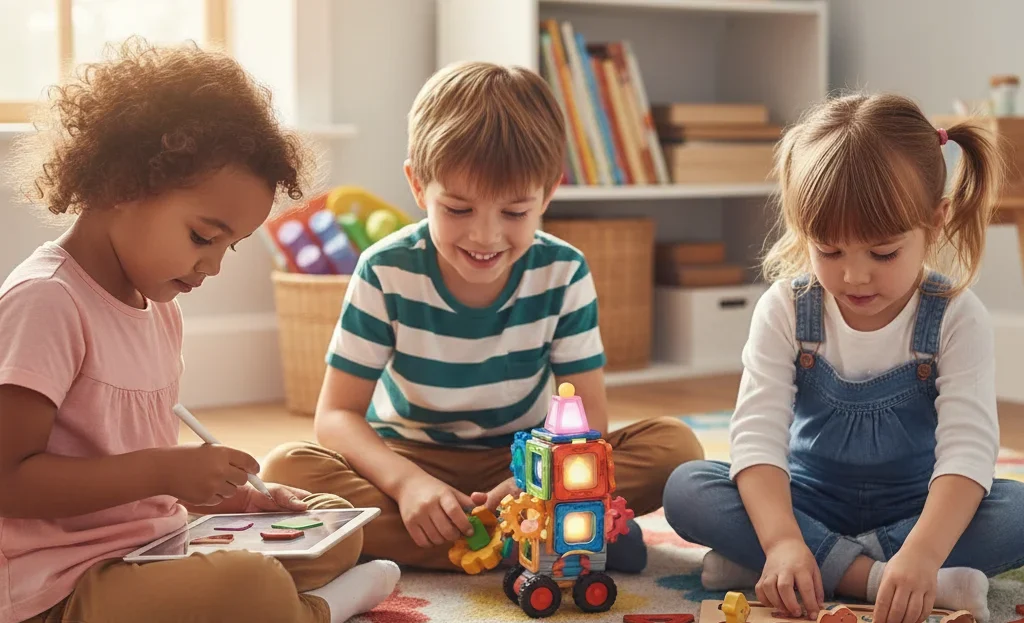
May
Educational Games for Kids
Discover the best Smart Games for Kids to boost cognitive development. This guide shows you how they perfectly combine learning and fun. It’s the smartest way to grow the mind through play.
What Are Smart Toys for Children?
Definition and Key Features
Smart toys for children are toys designed with a specific educational purpose. They go beyond simple entertainment to actively stimulate mental growth. Their features? They offer a challenge suited to the child’s age and promote critical thinking. They are often “open-ended”, allowing multiple solutions and creative uses. The goal is to foster learning in a spontaneous and enjoyable way.
Difference Between Smart Games and Traditional Toys
The difference lies entirely in the primary goal. A traditional toy entertains without a specific educational aim. Smart Games for Kids, on the other hand, are designed to develop skills. A remote-controlled car is just fun; an educational robotics kit teaches coding and engineering. They require active cognitive effort, such as solving problems. Remember, even a traditional toy can become “smart” when used creatively.
The Importance of Play in Cognitive Development
Play is the real work of childhood and is essential for cognitive development. Through it, the child absorbs complex concepts and experiences the consequences of their actions. Games for cognitive development structure this experience, guiding children toward specific milestones. This practice strengthens neural connections and lays the foundations for the future. Choosing the right Smart Games for Kids means investing in their potential.
The Benefits of Smart Games for Child Development
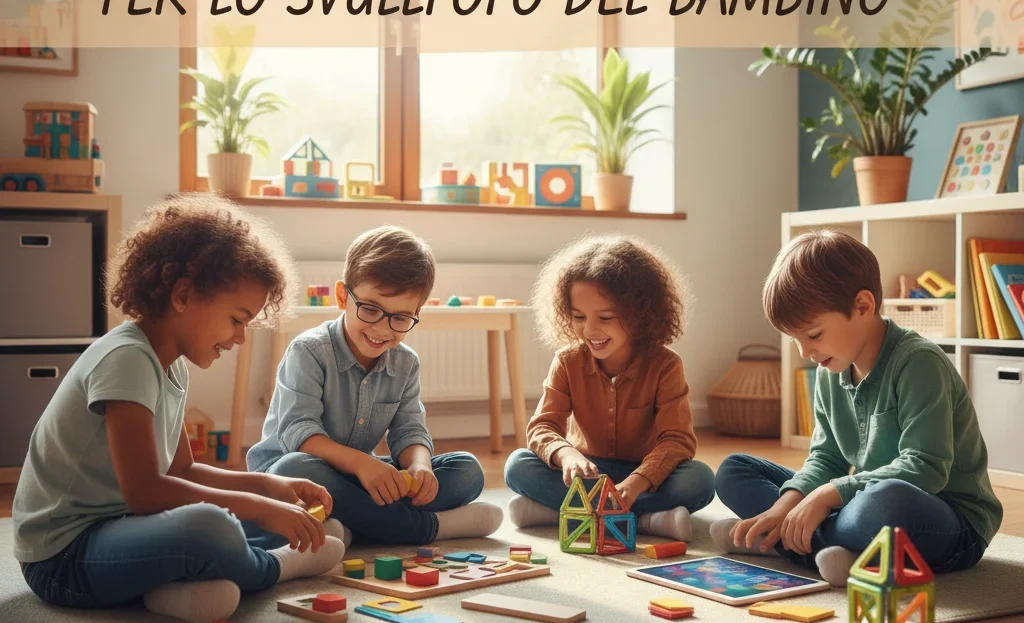
Stimulating Logical Skills and Problem Solving
Puzzles, mazes and smart construction sets train the mind to think sequentially. The child learns to make hypotheses, test solutions and correct mistakes. Memory and logic games also strengthen concentration and pattern recognition. They lay solid foundations for mathematical and scientific thinking. They are fun and rewarding mental exercise.
Encouraging Creativity and Imagination
Contrary to popular belief, smart games are not rigid. Many, such as advanced construction sets, are deliberately open-ended to encourage invention. A set of blocks can become a castle, a rocket or an entire city. Creative games, often inspired by the Montessori method, value freedom of exploration. Creativity also comes from finding new solutions to a problem.
Developing Social and Emotional Skills
Many educational board games teach children to take turns, follow rules and manage frustration. Role-play and puppets allow them to explore and name emotions. Working together toward a goal strengthens communication and cooperation skills. These experiences are valuable for the child’s emotional and social growth.
Types of Smart Games for Every Age Group
Games for Early Childhood (0-3 years)
At this stage, sensorimotor development is central. Games aim to stimulate the senses and refine coordination.
Sensory and Manipulation Games
Toys with different textures, rattles or soft cubes with mirrors are ideal. Educational wooden games, such as threading beads, are also perfect. They help develop grip and hand-eye coordination. Tactile and auditory exploration is the first form of learning.
Soft and Stackable Blocks
Fabric cubes and stacking rings teach concepts of size and balance. The child learns through doing, experiencing what happens when a tower falls. They are often among the first games for learning to count or recognise colours. Their safety is essential, given the tendency to put everything in the mouth.
Games for Preschool Age (3-6 years)
This is the age of language explosion, curiosity and symbolic play. Toys become more complex.
Puzzles, Shape Sorters and Matching Games
Puzzles with a few large pieces or shapes to fit into the right spaces. These games boost visual perception, logic and patience. They are also great for learning the alphabet and numbers in a playful way. They build self-confidence when the child solves the task on their own.
Simple Role-Play Games and Puppets
Miniature kitchens, work tools or a puppet theatre. Through “pretend play”, children process reality and experiment with social roles. These games are essential for emotional and imaginative development. They encourage storytelling and sharing with peers.
Games for School Age (6-12+ years)
Thinking becomes more abstract and systematic. Children are ready for complex challenges and specific interests.
Educational and Strategy Board Games
Games that require planning, tactical memory or knowledge of geography and mathematics. They are excellent logic games that teach players to think several moves ahead. They encourage family evenings and healthy competition among friends. They are often the most appreciated smart gifts for children.
Science Kits and Advanced Construction Sets
This category fully includes STEM games and educational robotics. Kits for experiments, telescopes or simple electrical circuits. These science games turn abstract concepts into concrete experiences. Coding for kids often happens through programmable robots, combining technology and fun.
How to Choose the Right Smart Games for Your Child
Assessing Age, Interests and Individual Abilities
The age on the packaging is a guide, not a rule. Observe your child: are they more inclined toward logic or creativity? The best educational games respect their stage of development. They should be neither too easy (boring) nor too hard (frustrating). A game for 3-year-olds will be different from one for 5-year-olds. Choose together, valuing their passions.
The Importance of Quality, Safety and Materials
Prefer durable toys made from non-toxic, safe materials. Educational wooden games are often synonymous with sturdiness and sustainability. Always check safety certifications (CE). Solid construction guarantees longevity and conveys a sense of value. A good brain game is an investment that can last for years.
Finding a Balance Between Structured Play and Free Play
Not every play moment needs a predetermined educational goal. Alternate brain games with unstructured activities, where imagination reigns free. Educational apps also have their place, but screen time should be limited. Balance is the key: guided play develops skills, while free play nourishes the soul and independence.
❓ Frequently Asked Questions
What Are Smart Games for Kids?
Smart games for kids are toys designed with a specific educational purpose to stimulate mental growth. They go beyond simple entertainment, offering age-appropriate challenges and encouraging critical thinking in a spontaneous and enjoyable way.
What is the difference between smart games and traditional games?
The main difference lies in the goal: traditional games entertain without an educational purpose, while smart games for kids are designed to develop specific skills. They require active cognitive engagement, such as solving problems or learning concepts like coding.
Why are smart games for kids important for cognitive development?
They are essential because they structure the play experience, guiding the child toward specific learning milestones. This practice reinforces neural connections, helps absorb complex concepts and lays solid foundations for the future development of logical and creative thinking.
What skills do smart games for kids develop?
They mainly stimulate logical and problem-solving skills, teaching children to form hypotheses and test solutions. They also promote creativity and imagination through open-ended games that encourage multiple uses and creative solutions, while strengthening concentration and memory.
How do you choose the most suitable smart games for kids?
It is essential to select games that offer a challenge appropriate to the child’s age and abilities, often preferring ‘open-ended’ options with multiple solutions. Choosing the right smart games for kids means investing in their learning potential in a fun and rewarding way.
💡 How to Choose and Use Smart Games for Kids
7 Steps
- Understand What They Are
Recognise smart games as toys designed with a specific educational purpose, going beyond simple entertainment. They are intended to actively stimulate mental growth, offering a challenge suited to the child’s age and promoting critical thinking. They are often ‘open-ended’, allowing multiple solutions and creative uses to foster spontaneous learning. - Recognise the Difference from Traditional Toys
Distinguish them from traditional toys, whose primary goal is only fun without a specific educational purpose. Smart games, such as a robotics kit, require active cognitive engagement to develop skills like problem solving. Remember that even a traditional toy can become ‘smart’ when used with creativity and an educational purpose. - Assess the Importance for Cognitive Development
Consider that play is fundamental to a child’s cognitive development, since through it they absorb complex concepts. Smart games structure this experience, guiding toward specific milestones that reinforce neural connections. Choosing suitable ones means investing in the child’s potential, laying solid foundations for the future. - Choose Games That Stimulate Logic and Problem Solving
Select games such as puzzles, mazes and clever construction sets that train the mind to think sequentially. These tools teach the child to form hypotheses, test solutions and correct mistakes, strengthening concentration and pattern recognition. They are fun mental training that lays the groundwork for mathematical and scientific thinking. - Encourage Creativity and Imagination
Opt for smart games that, contrary to the idea of rigidity, are deliberately open to encourage imagination. Advanced construction sets or unstructured materials allow creative uses and multiple solutions. This approach fosters personal expression and the development of divergent thinking in a pleasant learning context. - Make Sure They Are Age-Appropriate
Always verify that the challenge posed by the game matches the child’s age and abilities, to avoid frustration or boredom. A game that is too simple does not stimulate, while one that is too complex can demotivate. The goal is to offer a level of difficulty that encourages effort and allows the child to experience success, supporting growth step by step. - Integrate Play into the Daily Routine
Incorporate smart games into everyday activities naturally, as a shared and enjoyable learning moment. Give the child room to explore and use the games independently, observing without intervening excessively. This encourages spontaneous learning and reinforces the idea that learning can be a joyful and rewarding experience.