
Montessori Toys for Kids
What Are Montessori Toys?
What Are Montessori Toys?
Discover what Montessori Games are: educational tools designed to stimulate independent learning. This article explains in detail what they are and all their benefits for development.
What Are Montessori Games: An In-Depth Definition
When one asks what Montessori games are, we are talking about specific educational tools, often called Montessori materials. They are not simple toys, but fundamental components of the Montessori method. They are designed to support the child’s natural development through autonomypractical learning and direct experience.
Their essence goes beyond ordinary play. To answer “what Montessori games are” means understanding that they are working materials with a precise developmental purpose. They foster independent learning autonomy and are a distinctive feature of this children’s education.
The Montessori Philosophy Behind Educational Play
The Montessori pedagogy, created by Dr. Maria Montessori, sees the child as naturally curious. Education must respect their rhythms and their “sensitive periods,” phases during which they are highly receptive. In this context, play is the child’s true “work.”
The Montessori games embody principles such as respect for the individual and freedom of choice within a structured environment. The goal is not to entertain, but to give children the keys to explore the world. This approach revolutionizes the concept of educational toys, focusing on the process rather than the outcome.
Distinctive Features: What Makes a Game “Montessori”?
An authentic Montessori material has precise characteristics. It is beautiful, preferably made from natural materials such as wood or glass. Each game isolates one difficulty at a time, allowing the child to focus on a single quality, such as shape or size.
It features a built-in “control of error”: the child notices their own mistake without an adult. This fosters self-correction and independence. They are designed for a specific use, promoting order and repetition, key elements of Montessori teaching.
The Key Benefits of Montessori Games for Child Development
Developing Autonomy and Independence
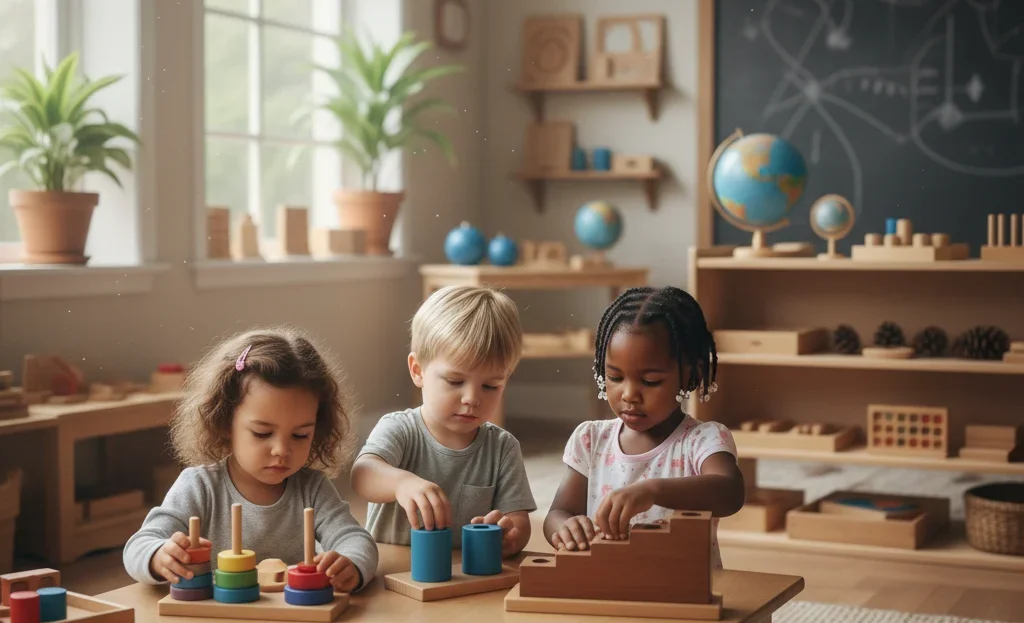
I Montessori materials are accessible and designed for independent use. This design encourages children to “do it themselves,” building confidence and practical skills. The freedom of choice choice among age-appropriate activities strengthens decision-making skills.
Through the attività manuali of practical life, such as pouring water, the child gains real independence. This sense of mastery is a pillar for healthy cognitive development and emotional development.
Sensory and Cognitive Stimulation
The Montessori method places great emphasis on the sensory. Materials such as the solid insets or the color tablets refine touch, sight, and hearing. This sensory education is the foundation for organizing the information of the world.
These concrete experiences prepare the mind for more complex abstract concepts. Working with shapes and volumes helps build fundamental mental schemas for mathematics, geometry, and language.
Improving Concentration and Problem-Solving Skills
I Montessori games for children capture interest and invite repetition. This voluntary repetition builds deep concentration. The child learns to complete a work cycle, following a logical sequence.
The “control of error” turns every challenge into an opportunity for problem solving. The child tries different strategies, developing critical thinking, perseverance, and a resilient mindset.
Types of Montessori Games and Exemplary Teaching Materials
Practical Life Games
These activities are the heart of the approach for the youngest children, especially in the Children’s House. They include exercises in personal care (dressing) and care of the environment (pouring, cutting). They use real objects, sized for children.
They develop eye-hand coordination, order, and a sense of responsibility. They are the foundation for all other areas of learning.
Sensorial Materials and Their Purpose
Sensorial materials are iconic of the Montessori method. They serve to refine the senses and to classify impressions of the world. Classic examples are the Pink Tower (for size) and the Brown Stairs (for thickness).
These materials make abstract qualities tangible. Working with them indirectly prepares for mathematics and geometry, developing a logical and aesthetic sense.
Games for Developing Language and Mathematics
For language, the process starts with enriching vocabulary and progresses to sandpaper letters. In mathematics, it starts with concrete concepts such as quantity and symbols, using beads and number rods.
The approach is always concrete and sensorial before becoming abstract. The child “handles” letters and quantities, gaining a physical experience of learning.
Examples for the Preschool Age
For preschool children, examples include: pouring trays, dressing frames, insets, sandpaper letters, the Pink Tower, and simple puzzles. The emphasis is on the practical life and on sensory discovery.
Examples for School Age
In the Montessori school, the materials become more abstract. Examples include the stamp game for mathematics, the bead chains, the multiplication board and the grammar boxes.
How to Choose and Implement Montessori Toys at Home
A Guide to Selection by Age and Interests
Choose according to the child’s “sensitive periods”, not only therecommended Montessori age. For a two-year-old who loves to sort, solid insets are perfect. For a four-year-old fascinated by letters, opt for sandpaper letters.
Observe the child: their interests are the best guide. Better a few materials, well presented, than a room overflowing with toys. Quality always beats quantity.
Creating a Prepared Montessori Environment at Home
L’prepared environment is a cornerstone principle. Organise the home to encourage independence and safe exploration. Use low shelves with only a few Montessori games tidy items. Prefer child-sized furniture, such as a low table.
Organise activities on trays complete with everything needed, to encourage order and independence. A low mirror and small kitchen utensils are excellent additions forhands-on learning.
Practical Tips for Using the Materials Effectively
Present one material at a time, demonstrating its use with slow, precise movements. Then let the child explore. Avoid interrupting them while they are concentrating. Respect the work cycle: take, use, return.
Encourage repetition, as it is a sign of deep learning. Do not correct directly but, if needed, re-present the material later. The goal isindependent learning learning driven by the child’s curiosity, the founding principle of this preschool education.
Useful reading:
Also read:
| Montessori Method Examples at Home |
| DIY Montessori Games |
❓ Frequently Asked Questions
What Are Montessori Toys?
Montessori toys are specific educational materials designed to support the child’s natural development through practical learning and direct experience. They are not simple toys, but fundamental tools of the Montessori method that promote independence.
What are the main features of a Montessori toy?
A genuine Montessori toy is made from natural materials, isolates one difficulty at a time to encourage concentration and includes a built-in ‘control of error’. This allows the child to self-correct, developing independence and order.
What benefits do Montessori toys offer for child development?
These toys encourage independence, self-confidence and the child’s practical skills. They promote self-directed learning, respecting natural rhythms and the sensitive periods of development, and they revolutionise the concept of the educational toy.
How do Montessori toys differ from traditional toys?
Unlike common toys that mainly entertain, Montessori toys are ‘work materials’ with a precise developmental purpose. They focus on the learning process and direct experience, rather than simply on the result or entertainment.
What is the child’s role when using Montessori toys?
The child is at the centre of the experience, free to choose and use the materials independently within a structured environment. Play is seen as their ‘work’, through which they explore the world and develop their natural abilities.
💡 How to Understand What Montessori Toys Are
6 Steps
- Defining the Concept
Montessori toys are not simple toys, but specific educational materials. They are fundamental tools of the Montessori method, designed to support the child’s natural development through practical learning and direct experience. - Understanding the Basic Philosophy
Montessori pedagogy, created by Maria Montessori, sees the child as naturally curious. The toys embody principles such as respect for the individual and freedom of choice within a structured environment, where play is the child’s ‘work’. - Identifying the Distinctive Features
A genuine Montessori toy is beautiful, often made from natural materials such as wood. It isolates one difficulty at a time, allowing the child to concentrate on a single quality, such as shape or size, and incorporates a ‘control of error’ for self-correction. - Recognising the Benefits for Autonomy
These materials are designed for independent use, encouraging the child to ‘do it themselves’. This approach builds confidence and practical skills and develops independence through freedom of choice within a prepared environment. - Distinguishing Them from Common Toys
The key difference is purpose: not to entertain, but to provide the keys to explore the world independently. They focus on the learning process rather than the final result, revolutionising the concept of the educational toy. - Choosing Appropriate Materials
Choose toys that isolate a specific quality (colour, weight, size) and allow self-correction. Prefer natural materials and miniature real objects that reflect the adult world, suited to the child’s sensitive period.