

Genitorialità
What Do 7- and 8-Year-Olds Like? A Complete Guide for Parents

Jun
Entering the world of a seven- or eight-year-old is like opening a book full of adventures, discoveries and endless questions. This is a magical age, a bridge between early childhood and the threshold of preadolescence. But exactly, what children aged 7 and 8 like? If you are asking yourself this question, you are in the right place. Understanding their interests will not only help you choose the right gifts, but also allow you to connect with them on a deeper level, supporting their growth in a fun and stimulating way. In this guide, we will explore their passions, from creative games to new technologies, offering practical ideas for parents, grandparents and uncles and aunts.
Key Takeaways
- At 7-8 years old, children develop logical thinking and greater social independence.
- Balancing screen time with hands-on and creative activities is crucial for their growth.
- Construction games, such as 3D puzzles, improve concentration and fine motor skills.
- Encouraging reading and outdoor play promotes healthy cognitive and physical development.
- Their interests range from scientific exploration to creativity and strategy in games.
Table of Contents

Cognitive and Social Development at 7-8 Years Old
At this age, children go through a crucial stage of development. Their thinking becomes more logical and organised. They begin to understand complex concepts such as cause and effect and to solve problems in a more structured way. According to the Bambino Gesù Children’s Hospital, this is the age in which reading and calculation skills develop significantly.
On the social level, friendship takes on a central role. Children begin to form closer bonds and to understand group dynamics. They want to feel competent and independent, so they appreciate activities that let them test themselves and reach a goal. This desire for autonomy is a powerful engine for learning and discovery.
Common Interests: What Captures Their Attention?
The interests of children aged 7 and 8 are a fascinating mix of creativity, logic and curiosity. Let’s look together at the areas that excite them most.
Exploration and Discovery of the World
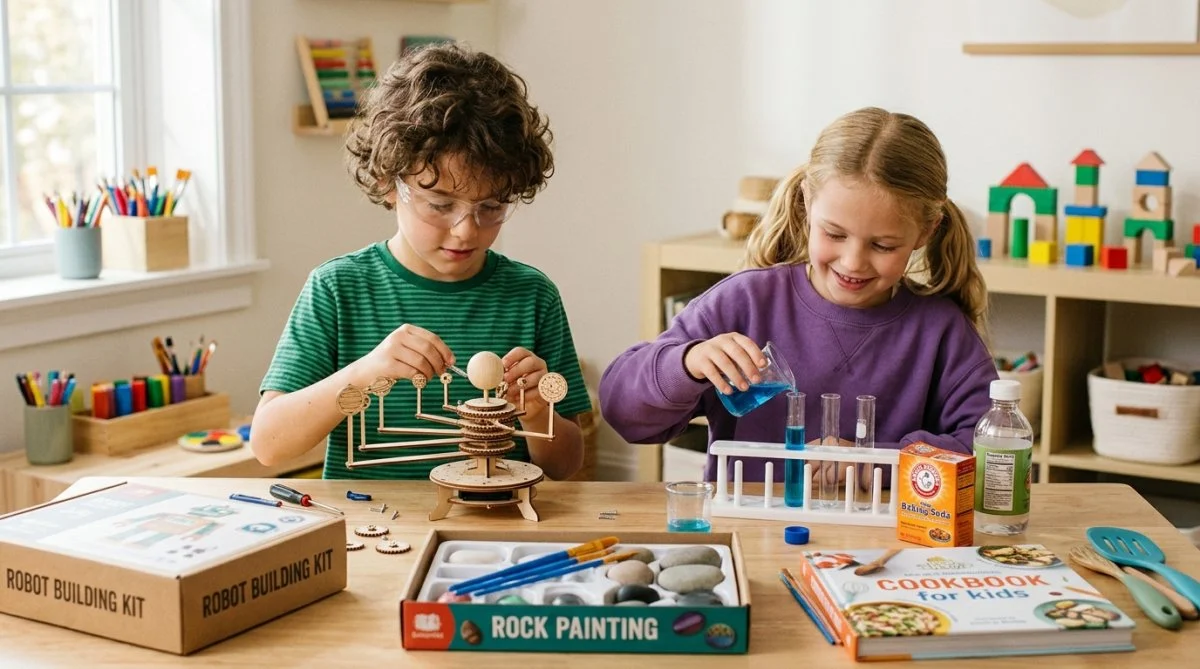
The question “why?” is always on the tip of their tongue. They love science experiments, books about animals, nature documentaries and visits to museums. Kits for young chemists, mineral sets or a good microscope can keep them busy for hours, feeding their thirst for knowledge.
Creativity and Construction
Building, creating, assembling: these activities are fundamental. It is not just about LEGO. Children of this age love projects that require precision and patience. The wooden models to build, for example, are a fantastic option. They allow children to follow complex instructions, develop fine motor skills and achieve a final result that brings great satisfaction. Also puzzles to build for 7-year-olds represent a stimulating challenge that helps them concentrate and think strategically.
Logic and Strategy Games
Strategy board games, complex puzzles, riddles and gamebooks are extremely popular. These games not only entertain them, but also sharpen their problem-solving skills. Also hands-on projects that follow a diagram, such as DIY Montessori games, can be a great way to combine manual skill and logic.
The Appeal of Technology (Managed in Moderation)
It is undeniable: video games, apps and online videos attract them like magnets. Technology can be a powerful educational tool, but it is essential to find a balance. Many parents wonder what to do when children are always on their phones. Limiting screen time and offering engaging alternatives is the key to preventing them from becoming children addicted to tablets. Choose games that stimulate creativity (such as Minecraft in creative mode) or logic.
Gift Ideas and Hands-On Activities to Amaze Them
Looking for the perfect gift? Here are some ideas based on the interests we have just seen, designed for children aged 7 and 8.
- Books and Gripping Stories: At this age, they move from picture books to their first novels for young readers. Choose gripping series (such as Harry Potter or Geronimo Stilton) or quality comics. Reading is essential for the development of language and imagination. UNICEF offers excellent advice for encouraging this habit.
- Creative and Science Kits: A set for making jewellery, a digging kit for finding fossils, a small garden to grow on the balcony. These hands-on activities produce tangible results and boost their self-esteem.
- Wooden 3D Puzzles: These are not simple puzzles. They are real miniature engineering projects. Assembling a music box, a vehicle or a mechanical animal without glue is a rewarding challenge that combines logic, patience and manual skill. Visit our shop to discover many models suitable for them.
- Board Games for the Whole Family: Games such as Dixit, Ticket to Ride or Carcassonne are perfect for involving the whole family, teaching respect for the rules and healthy competition.
The Importance of Free Play and Time Outdoors
Beyond structured games, it is essential to give children time for free play, not directed by adults. Running in a park, inventing stories with their soft toys, building dens with blankets and cushions. These activities are essential for developing creativity, independence and negotiation skills with peers. As many studies have shown, outdoor play improves physical and mental health, reduces stress and increases the ability to concentrate.
Frequently Asked Questions (FAQ)
What are the best educational games for an 8-year-old child?
For 8-year-olds, the best educational games are those that combine fun and learning in a challenging way. Great examples include complex construction sets such as mechanical 3D puzzles, beginner coding kits, strategic board games, and science experiment kits that let children explore chemistry and physics safely.
My son/daughter spends too much time playing video games. What can I do?
It’s a common concern. The key is open dialogue and setting clear rules, agreed upon together, about how much time is spent on screens. Offer alternatives that are just as appealing, such as a model-building project to do together, a new board game, or a sports activity. The important thing is to offer valid options rather than simply forbidding things.
Why are wooden 3D puzzles suitable for this age?
Wooden 3D puzzles are perfect for children aged 7 and 8 because they meet their need to challenge themselves and see a tangible result. They improve concentration, spatial vision and fine motor skills. In addition, the assembly process teaches patience and the importance of following instructions, all valuable skills for school and life.
In conclusion, understanding what children aged 7 and 8 enjoy means listening to them, observing them and offering them different stimuli. By encouraging them to explore, build and play, you will help them grow up curious, capable and happy. And who knows, you might even discover a new hobby to share with them!