

Wooden Modelling
Wooden Model Kits to Build: A Complete Guide to Creative Modelling

May
Key Takeaways
- Wooden model building is a relaxing hobby, a great stress-relief activity and an alternative to digital screens.
- Building models improves concentration, fine motor skills and problem-solving ability at any age.
- When choosing a kit, consider the quality of the wood, the precision of the laser cutting and the clarity of the instructions.
- You don’t need to be an expert: there are kits for every level, from complete beginners to the most demanding modellers.
- Personalise your creation: painting and varnishing the finished model adds a unique, personal touch.
Table of Contents
- Why Choose Wooden Models to Build?
- Types of Wooden Models: Which One to Choose?
- Buying Guide: What to Look for in a Model Kit
- Practical Tips for a Perfect Assembly
- Beyond Assembly: Personalising Your Model
- Frequently Asked Questions (FAQ) about Wooden Models to Build
Have you ever gotten lost admiring the intricate details of a miniature galleon or the mechanical marvel of a wooden clock? If so, you’re in the right place. I wooden models to build are much more than a simple pastime; they are a journey into creativity, an exercise in patience and a source of immense satisfaction. Whether you are an experienced hobbyist or a curious beginner, this guide will take you on a discovery of a fascinating world, where small pieces of wood turn into masterpieces.
This hobby combines the art of engineering with the warmth of wood, offering a unique tactile and visual experience. It is one of the best tablet alternatives for children for adults and children alike, a way to switch off and create something tangible with your own hands.
Why Choose Wooden Models to Build?
In a digital age, devoting yourself to a hands-on activity like wooden modelling offers invaluable benefits. It is not just about assembling pieces, but a complete experience that involves both mind and body.
A Relaxing and Anti-Stress Hobby
Focusing on assembling a model requires attention and precision. This focused process helps calm the mind, pushing away the stress and worries of everyday life. It is a form of active meditation that, according to several psychological studies, can improve mood and reduce anxiety. Handling wood, with its natural texture and scent, adds an extra element of connection with nature.
Developing Cognitive and Manual Skills
Building a wooden model is not only fun, it is also educational. This hobby stimulates:
- Problem-solving: Interpreting instructions and understanding how the pieces fit together is an excellent logic exercise.
- Patience and perseverance: More complex models require time and dedication, teaching the value of commitment.
- Fine motor skills: Handling small components improves hand-eye coordination and dexterity.
- Spatial vision: Understanding a three-dimensional object from two-dimensional diagrams strengthens visuospatial abilities.
For these reasons, the simpler kits are considered among the best educational toys for children, capable of teaching while entertaining.
The Satisfaction of “Handmade”
Few things beat the sense of pride you feel admiring a finished model, knowing you built it piece by piece. Each model becomes a unique decorative object, a trophy that testifies to your skill and dedication, ready to be displayed at home or in the office.

Types of Wooden Models: Which One to Choose?
The market offers an incredible variety of kits, suited to all tastes and skill levels. Finding your way can seem difficult at first, but simply knowing the main categories will help you make the right choice.
Kits for Beginners and Children
If you are new to the world of modelling, the ideal way to start is with a simple kit. These models usually have few pieces, larger dimensions and very clear instructions. They often depict animals, small vehicles or simple architectural structures. They are perfect for getting familiar with the materials and basic techniques.
Complex Mechanical Models (3D Puzzles)
This is our speciality! Mechanical models, often called 3D puzzles, are fascinating kits that, once assembled, can move. We are talking about music boxes, pendulum clocks, steam locomotives with working pistons and complex automata. These models use gears, levers and connecting rods, all made strictly of wood. Most of these kits fall into the category of wooden 3D puzzle without glue, where the pieces snap together under pressure with millimetre precision.
Classic Static Modelling
It includes faithful reproductions of ships, aircraft, cars and historic buildings. These kits aim for maximum realism and often require more advanced techniques such as the use of glue, painting and the addition of meticulous details. They are ideal for those who love history and want to create display pieces with a strong visual impact. A classic example is ship modelling, a field with a long and noble tradition, as described on its Wikipedia page.
Buying Guide: What to Look for in a Model Kit
Have you decided to start? Fantastic! Now let’s see how to choose the perfect kit for you in our online shop or elsewhere.
Wood Quality and Laser Cutting
The quality of the material is essential. The best kits use birch or lime plywood sheets, which are strong and flexible. Cutting the pieces is another crucial aspect: laser cutting technology guarantees absolute precision, allowing perfect joints without burrs. An imprecise cut can turn a relaxing experience into a frustrating one.
Clear and Detailed Instructions
A good instruction manual is your best friend. Look for kits with clear diagrams, numbered steps and 3D illustrations showing exactly where each piece goes. Some manufacturers also offer online video tutorials, a valuable help if you have any doubts.
Indicated Difficulty Level
Most manufacturers state a difficulty level on the packaging (e.g. from 1 to 5 stars) and an estimated assembly time. Be honest with yourself: starting with a model that is too complex can be discouraging. It is much better to begin with something simpler and get an early win that motivates you to keep going.
Practical Tips for a Perfect Assembly
Once you have received your kit, follow these simple tips for a smooth and rewarding experience.
Prepare Your Workspace
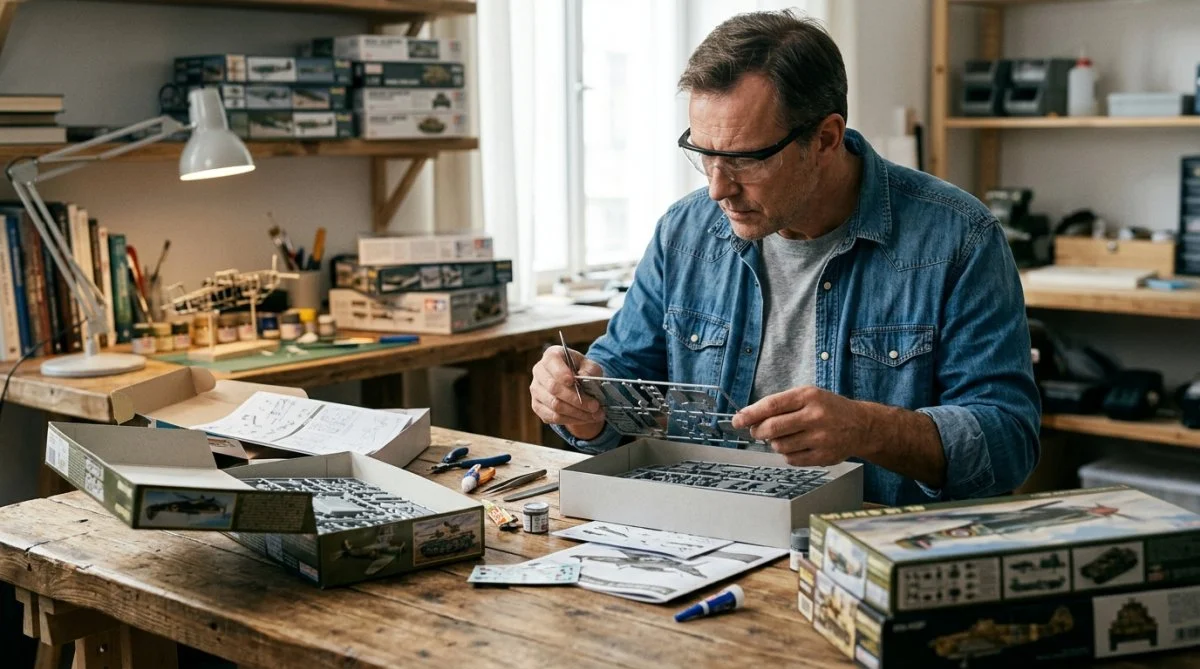
Choose a flat, well-lit and clean surface. Use a cutting mat to protect the table. Keep the wooden sheets with the pre-cut pieces in order and detach only the components needed for the current step, to avoid losing or mixing them up.
Useful Tools
Although many kits do not require tools, a few small accessories can make a difference:
- Fine sandpaper: To gently smooth any small imperfections on the edges of the pieces.
- Wax (often included): Essential for lubricating the gears and moving parts in mechanical models.
- Tweezers: Useful for handling the smallest components.
Follow the Instructions… but Take Your Time!
Don’t rush. Read each step carefully before you start assembling. Check the orientation of the parts: sometimes a component fitted the wrong way can compromise the entire mechanism. Model building is a marathon, not a sprint.
Beyond Assembly: Personalising Your Model
The fun doesn’t end with the last piece! Wood is a wonderful material that lends itself to endless customisation. You can choose to leave the model natural to appreciate its grain, or give it a unique touch.
You can use acrylic paints, wood stains or spray paints to colour your model before or after assembly. A coat of protective clear varnish (glossy or matte) can protect it from dust and humidity, ensuring it lasts over time. This is the stage where your creativity can really shine!
They are wooden models to build are a gateway to a world of creativity, patience and satisfaction. They make a perfect gift for yourself or a loved one, an opportunity to learn new skills and create objects you can be proud of. Are you ready to start your adventure? Browse our collection and find the model that will spark your creative flame.
Frequently Asked Questions (FAQ) about Wooden Models to Build
Is glue needed to assemble the models?
It depends on the type of kit. Most modern mechanical 3D puzzles, like those you’ll find on our site, are designed to be assembled with interlocking joints, without a single drop of glue. The high-precision laser cutting ensures a solid assembly. Traditional static model making, on the other hand, almost always requires the use of specific wood glues.
Are wooden models suitable for children?
Absolutely! There are many kits designed specifically for younger builders, with large parts and simple mechanisms. It’s a fantastic activity for developing manual dexterity and concentration, and a great opportunity for a family project. Always check the recommended age on the packaging.
How long does it take to build a model?
The time varies greatly depending on the complexity of the model and your experience. A beginner’s kit may take from 1 to 3 hours, while a complex mechanical model such as a large clock or a galleon can take more than 10-15 hours of work, which can be split into several sessions.
Can I paint my wooden model once it’s finished?
Of course! Personalising the model is one of the most enjoyable parts. You can use acrylic paints, tempera, markers or wood stains. It’s advisable to test on a scrap piece first to see how the colour looks. Some people prefer to paint the parts before detaching them from the sheet, others after completing the assembly.